
Alnylam Pharmaceuticals (ALNY)
Develops and commercializes RNAi medicines led by the AMVUTTRA-centered TTR franchise.
Something off on this page? Send us feedback.
Alnylam makes medicines that switch off a faulty gene in the body before it can build a harmful protein. For years that meant small rare-disease markets and steady losses. Then its lead drug was cleared for a heart condition affecting far more people, and the company turned profitable for the first time. Almost all the money now rides on that one medicine; the rest of the pipeline is the hedge.
Item facts: FY2025 · year ended Dec 31, 2025, from filings, earnings calls and company pages.
Judgment weights, not filed revenue
The band summarizes business focus and direction. ~ marks estimates.
7 in detail · 12 more below
AMVUTTRA (vutrisiran)
Alnylam's one big medicine — a shot every three months for a disease in which a liver protein deforms the heart and nerves. It passed a billion dollars in a single quarter, then management trimmed the 2026 forecast when switch-over demand cooled. Watch new patient starts.
Competes with Vyndaqel / Vyndamax (tafamidis) (Pfizer) · Attruby (acoramidis) (BridgeBio) · Wainua (eplontersen) (Ionis and AstraZeneca)
In plain English
In this disease a protein made by the liver misfolds and collects in the heart and the nerves. AMVUTTRA tells the liver to stop making it — less like mopping the floor, more like closing the tap.
Heart and nerve specialists give the injection in their own clinics and bill insurers for it, and about 170 U.S. health systems start most of the treatment. Management counts roughly 200,000 Americans with the heart form of the illness, about four in five of them untreated, so growth comes from finding and starting patients. Price per patient is drifting down on purpose, so volume has to do the work. In the U.S., a single wholesale distributor moves about 80% of the doses.
Nucresiran (ALN-TTRsc04)
The planned successor to AMVUTTRA, given twice a year instead of four times. Two final-stage trials are enrolling, with approval targeted for 2028 in the nerve disease and a 2030 launch in the heart one. It earns nothing today.
Competes with Wainua (eplontersen) (Ionis and AstraZeneca) · Attruby (acoramidis) (BridgeBio) · Vyndamax (tafamidis) (Pfizer)
In plain English
Think of it as version two of the company's main drug: same idea — tell the liver to stop making the harmful protein — but designed around two injections a year rather than four, and to push the protein down further. Early results showed more than 95% average knockdown.
No one pays for it yet. Its job is to answer the question hanging over a one-drug company: what carries the franchise after AMVUTTRA. A rival working the same way, from Ionis and AstraZeneca, missed its main goal in the heart disease in July 2026, which is the obvious worry for Alnylam's own heart trial — management says its conviction is undimmed.

GIVLAARI (givosiran)
A monthly injection that heads off the sudden attacks of a rare genetic disorder instead of treating them after they start. It brought in $308.5M in 2025 and grows in the low double digits. Diagnosis is the limit.
Competes with Panhematin (hemin infusion) (Recordati Rare Diseases) · Normosang (hemin infusion) (Recordati / Orphan Europe)
In plain English
A rare genetic fault that triggers sudden, severe attacks — that is acute hepatic porphyria. The old answer was an infusion to put out each fire once it had started. GIVLAARI quiets the gene behind the attacks so fewer of them start at all.
Specialist centres prescribe it and insurers pay. The same commercial machine that carries the big heart medicine carries this one, so each additional patient costs Alnylam very little to serve. The limit is diagnosis: the illness is easy to miss, and only patients someone identifies can be treated.
OXLUMO (lumasiran)
A quarterly injection for a rare inherited kidney disease, cleared for every age including newborns. It brought in $191.4M in 2025 and grows in the low double digits. The one direct rival is cleared only from age nine.
Competes with Rivfloza (nedosiran) (Novo Nordisk) · Transplant and supportive care (Transplant centres)
In plain English
One rare inherited kidney illness, which can need treating from the newborn years onward — that is the whole market here. OXLUMO turns down the gene driving it, given as a shot four times a year.
Children's kidney specialists and genetics clinics prescribe it, insurers pay, and revenue grows one confirmed case at a time: a genetic test has to name the exact subtype, because the neighbouring subtypes fall outside what the drug is approved for. Novo Nordisk sells a rival shot that works on a different step and is cleared only from age nine, which leaves the youngest patients to Alnylam.

Zilebesiran (Roche partnership)
A blood-pressure shot given twice a year, aimed at a patient population vastly larger than Alnylam's rare diseases. Roche funds the work and Alnylam books the payments — including a one-time $300M payment in 2025 for starting the final trial. No product sales before about 2030.
Competes with Generic blood-pressure pills (Generic drugmakers) · Leqvio (inclisiran) (Novartis)
In plain English
Most people with high blood pressure take a cheap daily pill — when they remember. Zilebesiran is an injection given twice a year that turns down a protein driving blood pressure, so the dose becomes a calendar appointment rather than a daily habit.
It sells nothing yet. The money is Roche, the drugmaker that partnered on it, paying for the work: $310M up front, development costs repaid as Alnylam spends them, and up to $2.5B more if targets are hit. The two would split U.S. profits down the middle. First, an outcomes trial of roughly 11,000 patients has to run its course.
Regeneron alliance
A research alliance with Regeneron covering immune-system, brain and eye targets, several already in final-stage testing. Regeneron pays for the programs it runs and Alnylam books those payments. The pace is Regeneron's to set, and it eased in 2026.
Competes with Ultomiris and Soliris (AstraZeneca (Alexion)) · Tominersen (Roche and Ionis)
In plain English
Two drug companies agreed to hunt targets together: Regeneron brings its own medicines and runs trials, Alnylam brings the gene-silencing technique. Some programs Regeneron pays for and runs — cemdisiran, now in final-stage trials for a muscle-weakness disease, an eye disease and a blood disorder. Others, including one for Huntington's and one aimed at an Alzheimer's target, Alnylam leads with the profits split.
What reaches Alnylam is repayment of costs plus a payment each time a program clears a marker — lumpy by nature. In 2024 Regeneron was big enough to count as one of Alnylam's largest customers, about a tenth of gross revenue; that income fell through 2026 as Regeneron's activity eased.
Leqvio royalties (Novartis)
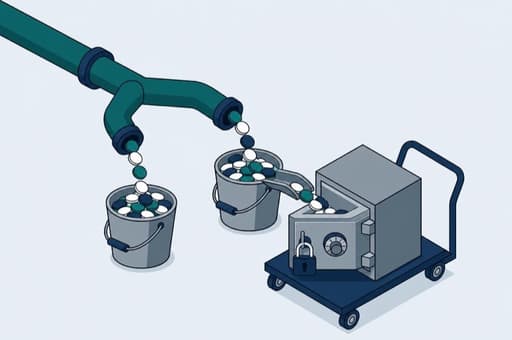
Alnylam invented a cholesterol-lowering shot, handed it to Novartis and now takes 10–20% of what it sells. Payments reached $120.6M in the first half of 2026, nearly double a year earlier. Blackstone owns half of them.
Competes with Repatha (evolocumab) (Amgen) · Praluent (alirocumab) (Regeneron and Sanofi)
In plain English
This is money Alnylam earns without selling anything. It discovered inclisiran, an injection that lowers cholesterol, then licensed it to Novartis, which runs the trials, makes the doses and sends out the sales reps. Novartis sold roughly $1.2B of it in 2025 and pays Alnylam a slice of every sale, the slice widening as the totals climb.
Two catches. Alnylam has no lever here — the number depends entirely on how hard Novartis pushes. And the company sold half of these payments to Blackstone, the investment firm, for a billion dollars up front, back when cash was scarce.


 AMVUTTRA (vutrisiran)Alnylam's one big medicine — a shot every three months for a disease in which a liver protein deforms the heart and nerves. It passed a billion dollars in a single quarter, then management trimmed the 2026 forecast when switch-over demand cooled. Watch new patient starts.
Alnylam's one big medicine — a shot every three months for a disease in which a liver protein deforms the heart and nerves. It passed a billion dollars in a single quarter, then management trimmed the 2026 forecast when switch-over demand cooled. Watch new patient starts.
In plain English
In this disease a protein made by the liver misfolds and collects in the heart and the nerves. AMVUTTRA tells the liver to stop making it — less like mopping the floor, more like closing the tap.
Heart and nerve specialists give the injection in their own clinics and bill insurers for it, and about 170 U.S. health systems start most of the treatment. Management counts roughly 200,000 Americans with the heart form of the illness, about four in five of them untreated, so growth comes from finding and starting patients. Price per patient is drifting down on purpose, so volume has to do the work. In the U.S., a single wholesale distributor moves about 80% of the doses.
Competes with Vyndaqel / Vyndamax (tafamidis) (Pfizer) · Attruby (acoramidis) (BridgeBio) · Wainua (eplontersen) (Ionis and AstraZeneca)
 Nucresiran (ALN-TTRsc04)The planned successor to AMVUTTRA, given twice a year instead of four times. Two final-stage trials are enrolling, with approval targeted for 2028 in the nerve disease and a 2030 launch in the heart one. It earns nothing today.
The planned successor to AMVUTTRA, given twice a year instead of four times. Two final-stage trials are enrolling, with approval targeted for 2028 in the nerve disease and a 2030 launch in the heart one. It earns nothing today.
In plain English
Think of it as version two of the company's main drug: same idea — tell the liver to stop making the harmful protein — but designed around two injections a year rather than four, and to push the protein down further. Early results showed more than 95% average knockdown.
No one pays for it yet. Its job is to answer the question hanging over a one-drug company: what carries the franchise after AMVUTTRA. A rival working the same way, from Ionis and AstraZeneca, missed its main goal in the heart disease in July 2026, which is the obvious worry for Alnylam's own heart trial — management says its conviction is undimmed.
Competes with Wainua (eplontersen) (Ionis and AstraZeneca) · Attruby (acoramidis) (BridgeBio) · Vyndamax (tafamidis) (Pfizer)
 GIVLAARI (givosiran)A monthly injection that heads off the sudden attacks of a rare genetic disorder instead of treating them after they start. It brought in $308.5M in 2025 and grows in the low double digits. Diagnosis is the limit.
A monthly injection that heads off the sudden attacks of a rare genetic disorder instead of treating them after they start. It brought in $308.5M in 2025 and grows in the low double digits. Diagnosis is the limit.
In plain English
A rare genetic fault that triggers sudden, severe attacks — that is acute hepatic porphyria. The old answer was an infusion to put out each fire once it had started. GIVLAARI quiets the gene behind the attacks so fewer of them start at all.
Specialist centres prescribe it and insurers pay. The same commercial machine that carries the big heart medicine carries this one, so each additional patient costs Alnylam very little to serve. The limit is diagnosis: the illness is easy to miss, and only patients someone identifies can be treated.
Competes with Panhematin (hemin infusion) (Recordati Rare Diseases) · Normosang (hemin infusion) (Recordati / Orphan Europe)
 OXLUMO (lumasiran)A quarterly injection for a rare inherited kidney disease, cleared for every age including newborns. It brought in $191.4M in 2025 and grows in the low double digits. The one direct rival is cleared only from age nine.
A quarterly injection for a rare inherited kidney disease, cleared for every age including newborns. It brought in $191.4M in 2025 and grows in the low double digits. The one direct rival is cleared only from age nine.
In plain English
One rare inherited kidney illness, which can need treating from the newborn years onward — that is the whole market here. OXLUMO turns down the gene driving it, given as a shot four times a year.
Children's kidney specialists and genetics clinics prescribe it, insurers pay, and revenue grows one confirmed case at a time: a genetic test has to name the exact subtype, because the neighbouring subtypes fall outside what the drug is approved for. Novo Nordisk sells a rival shot that works on a different step and is cleared only from age nine, which leaves the youngest patients to Alnylam.
Competes with Rivfloza (nedosiran) (Novo Nordisk) · Transplant and supportive care (Transplant centres)
 Zilebesiran (Roche partnership)A blood-pressure shot given twice a year, aimed at a patient population vastly larger than Alnylam's rare diseases. Roche funds the work and Alnylam books the payments — including a one-time $300M payment in 2025 for starting the final trial. No product sales before about 2030.
A blood-pressure shot given twice a year, aimed at a patient population vastly larger than Alnylam's rare diseases. Roche funds the work and Alnylam books the payments — including a one-time $300M payment in 2025 for starting the final trial. No product sales before about 2030.
In plain English
Most people with high blood pressure take a cheap daily pill — when they remember. Zilebesiran is an injection given twice a year that turns down a protein driving blood pressure, so the dose becomes a calendar appointment rather than a daily habit.
It sells nothing yet. The money is Roche, the drugmaker that partnered on it, paying for the work: $310M up front, development costs repaid as Alnylam spends them, and up to $2.5B more if targets are hit. The two would split U.S. profits down the middle. First, an outcomes trial of roughly 11,000 patients has to run its course.
Competes with Generic blood-pressure pills (Generic drugmakers) · Leqvio (inclisiran) (Novartis)
 Regeneron allianceA research alliance with Regeneron covering immune-system, brain and eye targets, several already in final-stage testing. Regeneron pays for the programs it runs and Alnylam books those payments. The pace is Regeneron's to set, and it eased in 2026.
A research alliance with Regeneron covering immune-system, brain and eye targets, several already in final-stage testing. Regeneron pays for the programs it runs and Alnylam books those payments. The pace is Regeneron's to set, and it eased in 2026.
In plain English
Two drug companies agreed to hunt targets together: Regeneron brings its own medicines and runs trials, Alnylam brings the gene-silencing technique. Some programs Regeneron pays for and runs — cemdisiran, now in final-stage trials for a muscle-weakness disease, an eye disease and a blood disorder. Others, including one for Huntington's and one aimed at an Alzheimer's target, Alnylam leads with the profits split.
What reaches Alnylam is repayment of costs plus a payment each time a program clears a marker — lumpy by nature. In 2024 Regeneron was big enough to count as one of Alnylam's largest customers, about a tenth of gross revenue; that income fell through 2026 as Regeneron's activity eased.
Competes with Ultomiris and Soliris (AstraZeneca (Alexion)) · Tominersen (Roche and Ionis)
 Leqvio royalties (Novartis)Alnylam invented a cholesterol-lowering shot, handed it to Novartis and now takes 10–20% of what it sells. Payments reached $120.6M in the first half of 2026, nearly double a year earlier. Blackstone owns half of them.
Alnylam invented a cholesterol-lowering shot, handed it to Novartis and now takes 10–20% of what it sells. Payments reached $120.6M in the first half of 2026, nearly double a year earlier. Blackstone owns half of them.
In plain English
This is money Alnylam earns without selling anything. It discovered inclisiran, an injection that lowers cholesterol, then licensed it to Novartis, which runs the trials, makes the doses and sends out the sales reps. Novartis sold roughly $1.2B of it in 2025 and pays Alnylam a slice of every sale, the slice widening as the totals climb.
Two catches. Alnylam has no lever here — the number depends entirely on how hard Novartis pushes. And the company sold half of these payments to Blackstone, the investment firm, for a billion dollars up front, back when cash was scarce.
Competes with Repatha (evolocumab) (Amgen) · Praluent (alirocumab) (Regeneron and Sanofi)
Named in filings, launches and programs
- ONPATTRO (patisiran)ProductThe original version of the heart-and-nerve drug, an IV drip every three weeks, now displaced by Alnylam's own quarterly shot: first-half sales fell from $102.0M to $38.9M.
- QFITLIA (fitusiran)ProductA hemophilia medicine Sanofi sells worldwide, approved in March 2025; Alnylam invented it and collects 15–30% of the sales.
- CyrillisPlatformAn in-house way of building the company's molecules, launched in 2025 to add manufacturing capacity and lower the cost of making each dose.
- Mivelsiran (ALN-APP)Product · Pre-revenueA brain-delivered silencer in mid-stage testing for cerebral amyloid angiopathy, a protein build-up in the brain's blood vessels, and for Alzheimer's.
- ALN-6400Product · Pre-revenueMid-stage program for two inherited bleeding disorders, one of them affecting roughly 70,000 people in the U.S.
- Obesity programs (ALN-2232, ALN-6222)Product · Pre-revenueTwo Alnylam-led mid-stage programs in obesity and weight management.
- Rapirosiran (ALN-HSD)Product · Pre-revenueLate-stage program in fatty liver disease, licensed out — Alnylam is paid at milestones and takes a cut of any eventual sales.
- ALN-ANG3Product · Pre-revenueLate-stage program in kidney disease caused by diabetes, also licensed out to a partner that runs it.
- ElebsiranProduct · Pre-revenueMid-stage hepatitis D program, licensed out; it has not come up once on the earnings calls on record.
- ALN-SODProduct · Pre-revenueMid-stage program in the SOD1 form of ALS, run by a partner with the profits split.
- ALN-BCATProduct · Pre-revenueAlnylam-led mid-stage program in liver cancer.
- Komodo Health partnershipEcosystemA data partnership expanded in June 2026 to widen the company's view of how patients are diagnosed and treated in everyday practice.
ONPATTRO (patisiran)Product
The original version of the heart-and-nerve drug, an IV drip every three weeks, now displaced by Alnylam's own quarterly shot: first-half sales fell from $102.0M to $38.9M.
QFITLIA (fitusiran)Product
A hemophilia medicine Sanofi sells worldwide, approved in March 2025; Alnylam invented it and collects 15–30% of the sales.
CyrillisPlatform
An in-house way of building the company's molecules, launched in 2025 to add manufacturing capacity and lower the cost of making each dose.
Mivelsiran (ALN-APP)Product · Pre-revenue
A brain-delivered silencer in mid-stage testing for cerebral amyloid angiopathy, a protein build-up in the brain's blood vessels, and for Alzheimer's.
ALN-6400Product · Pre-revenue
Mid-stage program for two inherited bleeding disorders, one of them affecting roughly 70,000 people in the U.S.
Obesity programs (ALN-2232, ALN-6222)Product · Pre-revenue
Two Alnylam-led mid-stage programs in obesity and weight management.
Rapirosiran (ALN-HSD)Product · Pre-revenue
Late-stage program in fatty liver disease, licensed out — Alnylam is paid at milestones and takes a cut of any eventual sales.
ALN-ANG3Product · Pre-revenue
Late-stage program in kidney disease caused by diabetes, also licensed out to a partner that runs it.
ElebsiranProduct · Pre-revenue
Mid-stage hepatitis D program, licensed out; it has not come up once on the earnings calls on record.
ALN-SODProduct · Pre-revenue
Mid-stage program in the SOD1 form of ALS, run by a partner with the profits split.
ALN-BCATProduct · Pre-revenue
Alnylam-led mid-stage program in liver cancer.
Komodo Health partnershipEcosystem
A data partnership expanded in June 2026 to widen the company's view of how patients are diagnosed and treated in everyday practice.