
AST SpaceMobile (ASTS)
Connects ordinary phones to low-Earth-orbit cellular broadband through mobile-operator partnerships.
Something off on this page? Send us feedback.
AST SpaceMobile is building a fleet of unusually large satellites meant to give an ordinary phone a signal straight from space, sold through the phone companies rather than to you. That service has not started, so it earns nothing yet. What comes in today is ground equipment carriers buy to get ready, plus defense work — small change beside what the fleet costs to build.
Item facts: FY2025 · year ended Dec 31, 2025, from filings, earnings calls and company pages.
Judgment weights, not filed revenue
The band summarizes business focus and direction. ~ marks estimates.
7 in detail · 10 more below
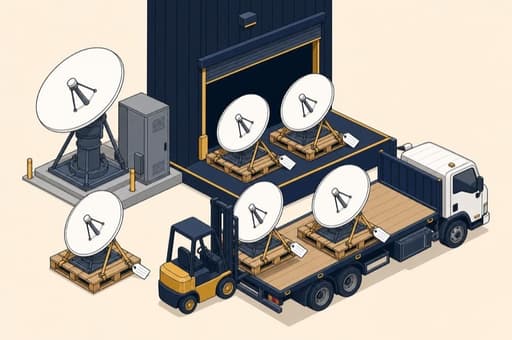
Gateway Equipment and Network Infrastructure
The ground kit that catches satellite traffic and hands it to a phone company's own network — about $44M in 2025, the bulk of all revenue. It arrives in lumps: $13.4M in early 2026, then $24.4M the next quarter.
Competes with Starlink Direct to Cell ground segment (SpaceX) · Ground network funded by Apple (Globalstar) · Satellite service reaching carriers without gateways (Skylo)
In plain English
Think of a call from orbit as a letter that still has to be sorted somewhere on the ground before it reaches your phone company. The gateway is that sorting office: a dish, a cabinet of electronics, and the software that passes the traffic across.
AST builds them; the carriers buy them, at roughly $1.9 million apiece, long before anyone can use the service. Thirteen went out in one recent quarter to seven buyers across five continents, with around fifty more in progress across twenty markets. It is partners paying to get ready for something that has not launched.
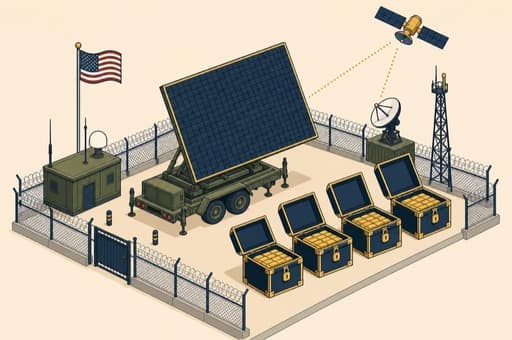
U.S. Government and Defense Programs
Staged payments from U.S. defense customers, earned on satellites already flying — most of the roughly $26M of service revenue in 2025. Management says sensing work, mainly radar, is the majority of it so far, not phone calls.
Competes with Starshield (SpaceX) · Transport and Tracking Layer satellites (Lockheed Martin) · Enhanced Mobile Satellite Services (Iridium)
In plain English
Defense agencies do not buy a satellite off a shelf. They write a contract in stages — reach this checkpoint, get paid; reach the next, get paid again — and AST does the work with spacecraft it already has up there.
The awards have been getting bigger: a $43 million contract from the Space Development Agency, a later $30 million award, then three more carrying over $100 million of near-term funded value, with the customers not named. Because every checkpoint depends on hardware being in orbit, a launch that slips pushes the payment with it.
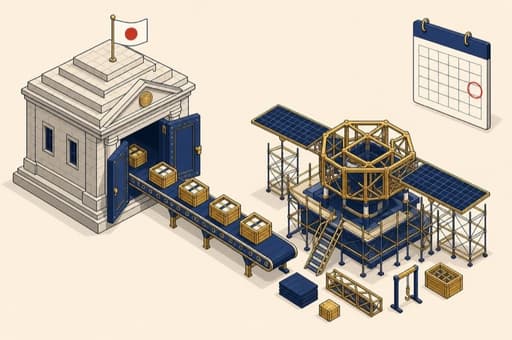
J-LEO — Japan's National Satellite Program
Japan chose a Rakuten-led bid to build a home-grown low-orbit network, with AST supplying it. Management describes up to about $1 billion of government money that is neither debt nor new shares — approvals still pending, service required by March 2029.
Competes with Starlink direct-to-cell via KDDI au (SpaceX) · IRIS² sovereign constellation (SpaceRISE)
In plain English
Governments have started to notice that the satellites over their territory belong to somebody else, and that outages leave them with no fallback. Japan's communications ministry ran a tender for a network of its own and picked a proposal led by Rakuten Mobile, a Japanese carrier.
AST would build and fly the spacecraft, through a satellite-operating venture expected to be owned equally with Rakuten Mobile. The money is the unusual part: reporting puts the state commitment near $922 million toward a roughly $2 billion network — cash that is not borrowed and does not hand over a slice of the company. Management treats it as the first of a kind it expects to repeat.
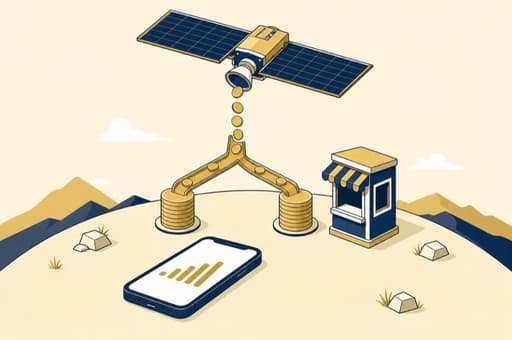
SpaceMobile Service
The actual product: an everyday phone getting broadband from orbit, sold through carriers who keep half. Nothing earned yet, against about $1.3B of contracted commitments as of August 2026. Management's $1 billion marker has slid from 2027 to "the first year of service".
Competes with T-Satellite direct-to-cell service (SpaceX with T-Mobile) · Satellite messaging and SOS on iPhone (Globalstar) · Direct-to-phone network on standard handsets (Lynk Global)
In plain English
This is what everything else is for. No special handset and no dish — the satellite behaves like a cell tower, so a phone already in a pocket can connect out where the towers stop.
AST does not sell it to you. Your carrier does, on its own airwaves and its own bill, and hands back half of what it collects — a split management has called untouchable since the company began. Money therefore arrives only when partners switch customers on, and how much of the map works depends on how many satellites fly: roughly twenty-five gives part-day coverage, forty-five to sixty makes it continuous across the U.S., Europe and Japan.
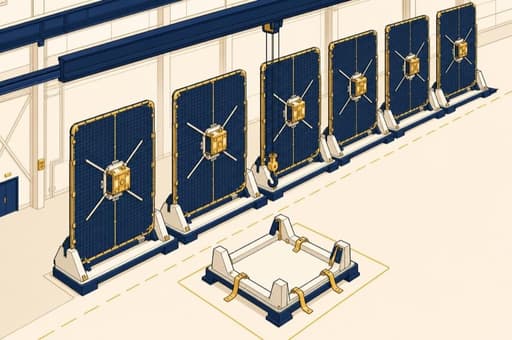
BlueBird Satellite Constellation
The fleet itself: enormous folding antennas in low orbit at roughly $21–23M each. About a dozen were up at the August 2026 update, one was lost outright, and the target of roughly forty-five has slipped from during 2026 to early 2027.
Competes with Starlink V3 direct-to-cell satellites (SpaceX) · Small direct-to-phone satellites (Lynk Global) · IRIS² constellation (SpaceRISE)
In plain English
A BlueBird is mostly antenna — the newest one carries a flat square array of about 223 square metres, folded for launch and opened out in orbit, because hearing a phone that was never built to shout at space takes an enormous ear.
They sell nothing on their own; they are the plant. AST builds them in its own factory in Midland, Texas, aiming at six a month, and rents rides upward from Blue Origin, SpaceX and ULA. That borrowed ride is the schedule risk: one BlueBird was declared a total loss, and the promise of roughly forty-five in orbit moved later across three straight earnings calls.

SatCo — European Joint Venture with Vodafone
A Luxembourg company owned fifty-fifty with the carrier Vodafone, holding the exclusive right to sell the service to European operators. Nothing sold yet; understandings signed in twenty-one of twenty-seven EU countries.
Competes with Direct carrier deals for Starlink in Europe (SpaceX) · IRIS² EU-backed programme (SpaceRISE)
In plain English
Instead of knocking on twenty-seven national doors alone, AST set up a company in Luxembourg with Vodafone, one of its carrier partners, each side owning half. SatCo holds the exclusive right to sell the SpaceMobile service to European operators, and is expected to run a small set of its own ground stations.
Nothing has been sold. Understandings are signed in twenty-one of the twenty-seven EU member states, and testing began in August 2026 with Vodafone, Orange, Telefónica, Vodafone Ukraine and Deutsche Telekom. Notice the cost of the arrangement: European money splits with Vodafone first and with the customer-owning carrier second, so AST's slice of a European phone bill sits well below half.
L-band and S-band Spectrum Rights
Long-term rights to radio airwaves AST controls itself — up to 45 MHz across the U.S. and Canada for more than eighty years, bought from Ligado for $550M. Owning airwaves is what could loosen the fifty-fifty split with carriers.
Competes with AWS-4 and H-block airwaves bought from EchoStar (SpaceX) · Big LEO L- and S-band holdings (Globalstar) · L-band mobile satellite airwaves (Viasat)
In plain English
Radio airwaves work like lanes on a road: only whoever holds a lane may broadcast in it, and everyone else has to borrow. The SpaceMobile service is built to run in lanes its carrier partners hold — which is precisely why those partners keep half the money.
So it bought lanes of its own: up to 45 MHz across the U.S. and Canada on rights running more than eighty years, for $550 million, most of which goes to Viasat's Inmarsat business. For scale, SpaceX paid $19.6 billion for 65 MHz from EchoStar — different lanes with different freedoms attached, not the same thing priced twice. The U.S. regulator has still to clear part of AST's package.


 Gateway Equipment and Network InfrastructureThe ground kit that catches satellite traffic and hands it to a phone company's own network — about $44M in 2025, the bulk of all revenue. It arrives in lumps: $13.4M in early 2026, then $24.4M the next quarter.
The ground kit that catches satellite traffic and hands it to a phone company's own network — about $44M in 2025, the bulk of all revenue. It arrives in lumps: $13.4M in early 2026, then $24.4M the next quarter.
In plain English
Think of a call from orbit as a letter that still has to be sorted somewhere on the ground before it reaches your phone company. The gateway is that sorting office: a dish, a cabinet of electronics, and the software that passes the traffic across.
AST builds them; the carriers buy them, at roughly $1.9 million apiece, long before anyone can use the service. Thirteen went out in one recent quarter to seven buyers across five continents, with around fifty more in progress across twenty markets. It is partners paying to get ready for something that has not launched.
Competes with Starlink Direct to Cell ground segment (SpaceX) · Ground network funded by Apple (Globalstar) · Satellite service reaching carriers without gateways (Skylo)
 U.S. Government and Defense ProgramsStaged payments from U.S. defense customers, earned on satellites already flying — most of the roughly $26M of service revenue in 2025. Management says sensing work, mainly radar, is the majority of it so far, not phone calls.
Staged payments from U.S. defense customers, earned on satellites already flying — most of the roughly $26M of service revenue in 2025. Management says sensing work, mainly radar, is the majority of it so far, not phone calls.
In plain English
Defense agencies do not buy a satellite off a shelf. They write a contract in stages — reach this checkpoint, get paid; reach the next, get paid again — and AST does the work with spacecraft it already has up there.
The awards have been getting bigger: a $43 million contract from the Space Development Agency, a later $30 million award, then three more carrying over $100 million of near-term funded value, with the customers not named. Because every checkpoint depends on hardware being in orbit, a launch that slips pushes the payment with it.
Competes with Starshield (SpaceX) · Transport and Tracking Layer satellites (Lockheed Martin) · Enhanced Mobile Satellite Services (Iridium)
 J-LEO — Japan's National Satellite ProgramJapan chose a Rakuten-led bid to build a home-grown low-orbit network, with AST supplying it. Management describes up to about $1 billion of government money that is neither debt nor new shares — approvals still pending, service required by March 2029.
Japan chose a Rakuten-led bid to build a home-grown low-orbit network, with AST supplying it. Management describes up to about $1 billion of government money that is neither debt nor new shares — approvals still pending, service required by March 2029.
In plain English
Governments have started to notice that the satellites over their territory belong to somebody else, and that outages leave them with no fallback. Japan's communications ministry ran a tender for a network of its own and picked a proposal led by Rakuten Mobile, a Japanese carrier.
AST would build and fly the spacecraft, through a satellite-operating venture expected to be owned equally with Rakuten Mobile. The money is the unusual part: reporting puts the state commitment near $922 million toward a roughly $2 billion network — cash that is not borrowed and does not hand over a slice of the company. Management treats it as the first of a kind it expects to repeat.
Competes with Starlink direct-to-cell via KDDI au (SpaceX) · IRIS² sovereign constellation (SpaceRISE)
 SpaceMobile ServiceThe actual product: an everyday phone getting broadband from orbit, sold through carriers who keep half. Nothing earned yet, against about $1.3B of contracted commitments as of August 2026. Management's $1 billion marker has slid from 2027 to "the first year of service".
The actual product: an everyday phone getting broadband from orbit, sold through carriers who keep half. Nothing earned yet, against about $1.3B of contracted commitments as of August 2026. Management's $1 billion marker has slid from 2027 to "the first year of service".
In plain English
This is what everything else is for. No special handset and no dish — the satellite behaves like a cell tower, so a phone already in a pocket can connect out where the towers stop.
AST does not sell it to you. Your carrier does, on its own airwaves and its own bill, and hands back half of what it collects — a split management has called untouchable since the company began. Money therefore arrives only when partners switch customers on, and how much of the map works depends on how many satellites fly: roughly twenty-five gives part-day coverage, forty-five to sixty makes it continuous across the U.S., Europe and Japan.
Competes with T-Satellite direct-to-cell service (SpaceX with T-Mobile) · Satellite messaging and SOS on iPhone (Globalstar) · Direct-to-phone network on standard handsets (Lynk Global)
 BlueBird Satellite ConstellationThe fleet itself: enormous folding antennas in low orbit at roughly $21–23M each. About a dozen were up at the August 2026 update, one was lost outright, and the target of roughly forty-five has slipped from during 2026 to early 2027.
The fleet itself: enormous folding antennas in low orbit at roughly $21–23M each. About a dozen were up at the August 2026 update, one was lost outright, and the target of roughly forty-five has slipped from during 2026 to early 2027.
In plain English
A BlueBird is mostly antenna — the newest one carries a flat square array of about 223 square metres, folded for launch and opened out in orbit, because hearing a phone that was never built to shout at space takes an enormous ear.
They sell nothing on their own; they are the plant. AST builds them in its own factory in Midland, Texas, aiming at six a month, and rents rides upward from Blue Origin, SpaceX and ULA. That borrowed ride is the schedule risk: one BlueBird was declared a total loss, and the promise of roughly forty-five in orbit moved later across three straight earnings calls.
Competes with Starlink V3 direct-to-cell satellites (SpaceX) · Small direct-to-phone satellites (Lynk Global) · IRIS² constellation (SpaceRISE)
 SatCo — European Joint Venture with VodafoneA Luxembourg company owned fifty-fifty with the carrier Vodafone, holding the exclusive right to sell the service to European operators. Nothing sold yet; understandings signed in twenty-one of twenty-seven EU countries.
A Luxembourg company owned fifty-fifty with the carrier Vodafone, holding the exclusive right to sell the service to European operators. Nothing sold yet; understandings signed in twenty-one of twenty-seven EU countries.
In plain English
Instead of knocking on twenty-seven national doors alone, AST set up a company in Luxembourg with Vodafone, one of its carrier partners, each side owning half. SatCo holds the exclusive right to sell the SpaceMobile service to European operators, and is expected to run a small set of its own ground stations.
Nothing has been sold. Understandings are signed in twenty-one of the twenty-seven EU member states, and testing began in August 2026 with Vodafone, Orange, Telefónica, Vodafone Ukraine and Deutsche Telekom. Notice the cost of the arrangement: European money splits with Vodafone first and with the customer-owning carrier second, so AST's slice of a European phone bill sits well below half.
Competes with Direct carrier deals for Starlink in Europe (SpaceX) · IRIS² EU-backed programme (SpaceRISE)
 L-band and S-band Spectrum RightsLong-term rights to radio airwaves AST controls itself — up to 45 MHz across the U.S. and Canada for more than eighty years, bought from Ligado for $550M. Owning airwaves is what could loosen the fifty-fifty split with carriers.
Long-term rights to radio airwaves AST controls itself — up to 45 MHz across the U.S. and Canada for more than eighty years, bought from Ligado for $550M. Owning airwaves is what could loosen the fifty-fifty split with carriers.
In plain English
Radio airwaves work like lanes on a road: only whoever holds a lane may broadcast in it, and everyone else has to borrow. The SpaceMobile service is built to run in lanes its carrier partners hold — which is precisely why those partners keep half the money.
So it bought lanes of its own: up to 45 MHz across the U.S. and Canada on rights running more than eighty years, for $550 million, most of which goes to Viasat's Inmarsat business. For scale, SpaceX paid $19.6 billion for 65 MHz from EchoStar — different lanes with different freedoms attached, not the same thing priced twice. The U.S. regulator has still to clear part of AST's package.
Competes with AWS-4 and H-block airwaves bought from EchoStar (SpaceX) · Big LEO L- and S-band holdings (Globalstar) · L-band mobile satellite airwaves (Viasat)
Named in filings, launches and programs
- stc Group 10-year agreementCustomer programA ten-year Saudi carrier deal that paid $175 million up front in 2025 — the one carrier commitment inside the contracted backlog with a public number.
- Radar and other non-communications workService · RampingSensing rather than phone calls. Management says it is the majority of government money earned so far; it sits inside the defense revenue, not beside it.
- Fairwinds Technologies teaming agreementCustomer programA U.S. government contractor that routes several defense awards to AST and ran the first government demonstration in June 2025.
- FirstNet / AT&T Band 14 public-safety programCustomer program · Pre-revenueTemporary permission to test phone-from-space on the U.S. first-responder band AT&T runs; the April 2026 regulator's order covers it. Nothing earned yet.
- MNO consulting servicesServiceAdvisory work for carrier partners that management names alongside the government awards — so not every service dollar is defense money.
- Satellite IoTProduct · AnnouncedA planned low-bandwidth service for machines — trackers and sensors — running on the airwaves AST controls itself. Announced, nothing sold.
- Space-based AI edge computeProduct · AnnouncedStated intent to do computing aboard the satellites instead of only relaying signals down. It first came up on the two most recent earnings calls.
- AST & Science, LLCBrandThe operating company beneath the listed one. It signs the Ligado airwave agreements, and outside holders own $551 million of it.
- Midland, Texas factoryPlatformAST builds its own satellites across more than 500,000 square feet in Midland, with another 400,000 announced — roughly 95% of the work kept in-house.
- Carrier partner rosterEcosystem · Pre-revenueSixty-plus mobile operators reaching more than three billion subscribers have signed on in some form — mostly promises to sell later, not money today.
stc Group 10-year agreementCustomer program
A ten-year Saudi carrier deal that paid $175 million up front in 2025 — the one carrier commitment inside the contracted backlog with a public number.
Radar and other non-communications workService · Ramping
Sensing rather than phone calls. Management says it is the majority of government money earned so far; it sits inside the defense revenue, not beside it.
Fairwinds Technologies teaming agreementCustomer program
A U.S. government contractor that routes several defense awards to AST and ran the first government demonstration in June 2025.
FirstNet / AT&T Band 14 public-safety programCustomer program · Pre-revenue
Temporary permission to test phone-from-space on the U.S. first-responder band AT&T runs; the April 2026 regulator's order covers it. Nothing earned yet.
MNO consulting servicesService
Advisory work for carrier partners that management names alongside the government awards — so not every service dollar is defense money.
Satellite IoTProduct · Announced
A planned low-bandwidth service for machines — trackers and sensors — running on the airwaves AST controls itself. Announced, nothing sold.
Space-based AI edge computeProduct · Announced
Stated intent to do computing aboard the satellites instead of only relaying signals down. It first came up on the two most recent earnings calls.
AST & Science, LLCBrand
The operating company beneath the listed one. It signs the Ligado airwave agreements, and outside holders own $551 million of it.
Midland, Texas factoryPlatform
AST builds its own satellites across more than 500,000 square feet in Midland, with another 400,000 announced — roughly 95% of the work kept in-house.
Carrier partner rosterEcosystem · Pre-revenue
Sixty-plus mobile operators reaching more than three billion subscribers have signed on in some form — mostly promises to sell later, not money today.