
CF Industries (CF)
Makes ammonia and upgraded nitrogen products for fertilizer, emissions control, and industry.
Something off on this page? Send us feedback.
CF Industries turns natural gas into nitrogen fertilizer at big plants across North America and the UK. Nothing it sells is special — one company's ammonia is the same as another's — so the money comes from cheap gas, running the plants nearly flat out, and deciding each quarter which product to make. The newer bet is ammonia whose carbon is captured and buried, sold at a premium to buyers who want it.
Item facts: FY2025 · year ended December 31, 2025, from filings, earnings calls and company pages.
Judgment weights, not filed revenue
The band summarizes business focus and direction. ~ marks estimates.
7 in detail · 11 more below
Ammonia
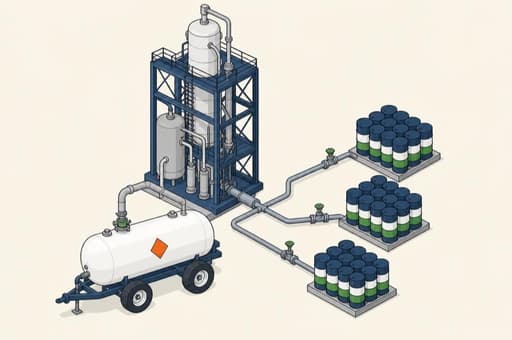
The base chemical CF makes from gas and sells as-is to farms and factories — $2.18 billion in 2025 at $473 a ton. It is also the raw material for everything else, so how much gets sold plain depends on what upgrading pays that quarter.
Competes with Ammonia, Nitrogen segment (Nutrien) · Ammonia from Wever, Iowa (Koch Ag & Energy Solutions) · European ammonia (Yara International)
In plain English
Ammonia is the plain nitrogen chemical CF cooks out of natural gas. Farmers inject it straight into the soil before planting; industrial customers buy it as a starting ingredient. Every producer's is identical, so nobody pays extra for the CF name.
The money sits in the gap between cheap North American gas and the world price of ammonia. Gas is about a third of what a ton costs to make, the plants ran at ninety-seven percent of capacity last year, and each extra ton lands on costs already paid for. Demand bunches into autumn, when farmers fertilize after the harvest.
Low-Carbon Ammonia Sales Program
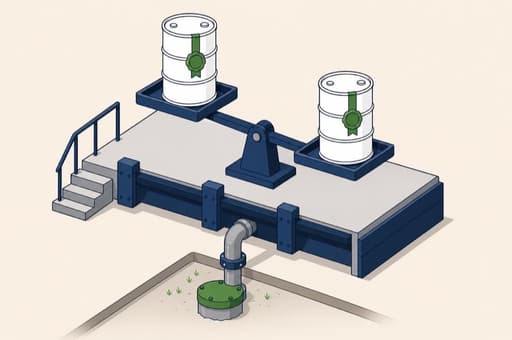
Ordinary ammonia sold with its carbon dioxide captured and buried instead of vented. About a tenth of first-half 2026 ammonia tons earned a premium of more than twenty dollars. Watch whether buyers keep paying without a carbon rule forcing them.
Competes with Beaumont low-carbon ammonia (Woodside) · European low-carbon nitrogen (Yara International)
In plain English
Making ammonia releases carbon dioxide. At the Donaldsonville complex CF now dries and squeezes that gas and hands it to ExxonMobil, which pumps it underground — up to two million metric tons a year.
What comes out is chemically the same ammonia as before; what is different is a certificate saying the carbon went into the ground rather than the air. Some buyers pay up for that. A cargo went to Envalior, a European chemical maker in Antwerp, handled by Trafigura; PepsiCo is putting certified low-carbon liquid fertilizer on the potatoes behind Frito-Lay snacks. US tax credits for storing carbon pay part of the bill.
Blue Point One
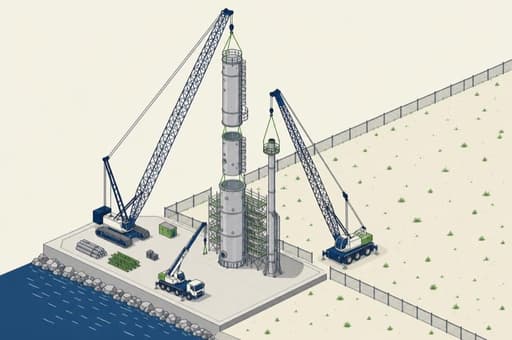
A $3.7 billion ammonia plant breaking ground in Louisiana, forty percent CF with JERA and Mitsui putting up the rest and taking product in proportion. Nothing sells until 2029, yet it carries most of the earnings step-up management promises by 2030.
Competes with Beaumont New Ammonia (Woodside) · Baytown blue ammonia (ExxonMobil)
In plain English
A new ammonia plant going up at Modeste, Louisiana — 1.4 million metric tons a year, with 98% of the carbon dioxide it makes captured instead of released.
CF is putting in 40% of the money. JERA and Mitsui, its two partners, put up the rest and each take ammonia in proportion to what they paid — so roughly a million tons a year of demand is spoken for before the plant exists. That is the unusual part: the customers helped build the factory. Until 2029 it is only spending, and because CF runs the project it carries the whole bill, partners' share included, through its own accounts.
UAN
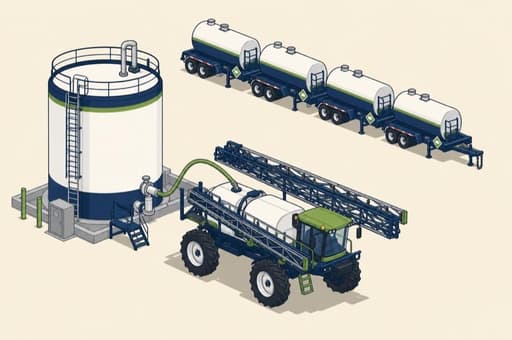
CF's biggest seller by tonnage: 6.9 million tons of sprayable liquid nitrogen at $311 a ton in 2025, a quarter more per ton than the year before on flat volume. How much gets made depends on whether urea pays better.
Competes with Solutions, nitrates and sulfates (Nutrien) · UAN (LSB Industries) · UAN imported into the EU and UK (Yara International)
In plain English
Think of it as fertilizer you can spray. Nitrogen dissolved in water, so a farmer runs it through a sprayer rather than injecting it into the ground. CF makes it by upgrading its own ammonia, which means every ton is a decision not to sell that ammonia plain.
Selling runs on a summer calendar. Each July CF opens what it calls a fill program: it names a price, distributors commit to tonnage, and the order book stretches into autumn — this year near $300 a ton, with orders booked into November. After that, the size of the market is simply how many acres of corn American farmers plant.
Granular Urea
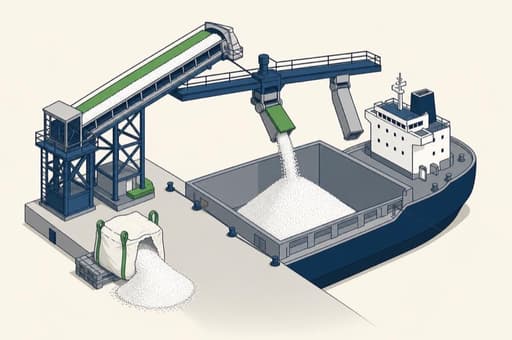
Dry urea pellets — 4.1 million tons at $433 in 2025, and the line CF has leaned into since: quarterly sales doubled to $759 million by mid-2026 as it steered plants toward urea and away from liquid. What China lets out and what India orders sets the price.
Competes with Urea and ESN (Nutrien) · Granular urea from Wever, Iowa (Koch Ag & Energy Solutions) · Exported granular urea (Chinese producers)
In plain English
Pellets you could pour like sugar. Dry urea keeps, loads onto ships easily and sells anywhere, so its price is set by a global market rather than by anything CF does.
Because ammonia can be turned into several different products, CF picks each quarter which one pays best, and lately that has been urea — management said it prioritised urea over liquid fertilizer, and the quarterly sales line doubled between late 2025 and mid-2026. New supply is expensive to add: 1.3 to 1.4 million tons of fresh capacity now costs $2.6–2.8 billion, so management reckons urea has to fetch $385 a ton, up from $355, before anyone starts building.
Diesel exhaust fluid and other nitrogen products
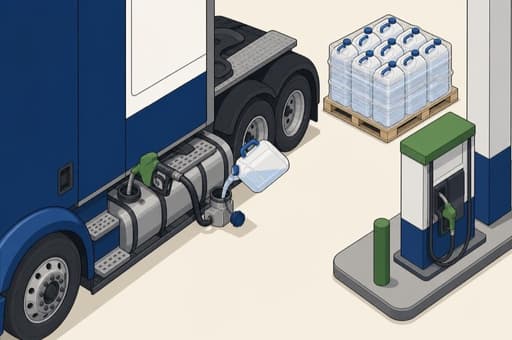
The catch-all line: 2.1 million tons at $262 in 2025, led by the fluid diesel trucks burn to clean their exhaust — management's highest-margin product in the first half of 2026. Orders arrive all year, not in a spring rush.
Competes with Air1 DEF (Yara International) · DEF and industrial nitrogen (LSB Industries) · Nitric acid and nitrates (Nutrien)
In plain English
Modern diesel trucks carry a second, smaller tank beside the fuel tank. It holds a clear liquid made from urea, sprayed into the hot exhaust to clean it before it leaves the pipe. Every truck running drinks the stuff continuously, so orders arrive in every week of the year rather than in the planting rush.
Alongside it sit a few industrial cousins — urea liquor, nitric acid, aqua ammonia — sold to factories. Management called diesel fluid its highest-margin product, put first-half volumes at its second-highest ever, and puts North American demand at a bit over two million tons of urea a year, heading past three by the end of the decade.
AN (ammonium nitrate)
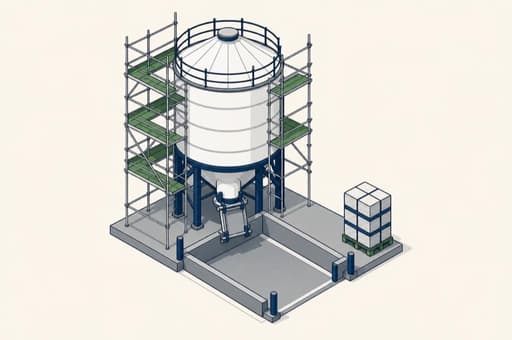
Ammonium nitrate for farms and for blasting rock — $421 million in 2025, until a November incident took down the complex management calls its only plant for the solution form. Quarterly sales fell by roughly a third; restart has slipped to the first half of 2027.
Competes with High-density ammonium nitrate (LSB Industries) · Nitrates (Nutrien) · European AN (Yara International)
In plain English
A solid, fast-acting form of nitrogen. Farmers in Britain and Europe spread it on fields; miners mix it to blast rock apart.
This is the piece of CF that is currently out of action. An incident in November 2025 shut the whole Yazoo City complex in Mississippi, and it has not run since. Insurance has paid about $75 million so far; even so, the outage costs roughly $200 million of earnings in 2026, and restart has moved from late 2026 to the first half of 2027 while CF waits on electrical gear. The rebuilt plant comes back making the liquid form, ammonia and diesel fluid — not the pellets it used to.


 AmmoniaThe base chemical CF makes from gas and sells as-is to farms and factories — $2.18 billion in 2025 at $473 a ton. It is also the raw material for everything else, so how much gets sold plain depends on what upgrading pays that quarter.
The base chemical CF makes from gas and sells as-is to farms and factories — $2.18 billion in 2025 at $473 a ton. It is also the raw material for everything else, so how much gets sold plain depends on what upgrading pays that quarter.
In plain English
Ammonia is the plain nitrogen chemical CF cooks out of natural gas. Farmers inject it straight into the soil before planting; industrial customers buy it as a starting ingredient. Every producer's is identical, so nobody pays extra for the CF name.
The money sits in the gap between cheap North American gas and the world price of ammonia. Gas is about a third of what a ton costs to make, the plants ran at ninety-seven percent of capacity last year, and each extra ton lands on costs already paid for. Demand bunches into autumn, when farmers fertilize after the harvest.
Competes with Ammonia, Nitrogen segment (Nutrien) · Ammonia from Wever, Iowa (Koch Ag & Energy Solutions) · European ammonia (Yara International)
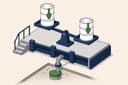 Low-Carbon Ammonia Sales ProgramOrdinary ammonia sold with its carbon dioxide captured and buried instead of vented. About a tenth of first-half 2026 ammonia tons earned a premium of more than twenty dollars. Watch whether buyers keep paying without a carbon rule forcing them.
Ordinary ammonia sold with its carbon dioxide captured and buried instead of vented. About a tenth of first-half 2026 ammonia tons earned a premium of more than twenty dollars. Watch whether buyers keep paying without a carbon rule forcing them.
In plain English
Making ammonia releases carbon dioxide. At the Donaldsonville complex CF now dries and squeezes that gas and hands it to ExxonMobil, which pumps it underground — up to two million metric tons a year.
What comes out is chemically the same ammonia as before; what is different is a certificate saying the carbon went into the ground rather than the air. Some buyers pay up for that. A cargo went to Envalior, a European chemical maker in Antwerp, handled by Trafigura; PepsiCo is putting certified low-carbon liquid fertilizer on the potatoes behind Frito-Lay snacks. US tax credits for storing carbon pay part of the bill.
Competes with Beaumont low-carbon ammonia (Woodside) · European low-carbon nitrogen (Yara International)
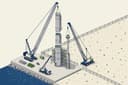 Blue Point OneA $3.7 billion ammonia plant breaking ground in Louisiana, forty percent CF with JERA and Mitsui putting up the rest and taking product in proportion. Nothing sells until 2029, yet it carries most of the earnings step-up management promises by 2030.
A $3.7 billion ammonia plant breaking ground in Louisiana, forty percent CF with JERA and Mitsui putting up the rest and taking product in proportion. Nothing sells until 2029, yet it carries most of the earnings step-up management promises by 2030.
In plain English
A new ammonia plant going up at Modeste, Louisiana — 1.4 million metric tons a year, with 98% of the carbon dioxide it makes captured instead of released.
CF is putting in 40% of the money. JERA and Mitsui, its two partners, put up the rest and each take ammonia in proportion to what they paid — so roughly a million tons a year of demand is spoken for before the plant exists. That is the unusual part: the customers helped build the factory. Until 2029 it is only spending, and because CF runs the project it carries the whole bill, partners' share included, through its own accounts.
Competes with Beaumont New Ammonia (Woodside) · Baytown blue ammonia (ExxonMobil)
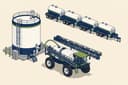 UANCF's biggest seller by tonnage: 6.9 million tons of sprayable liquid nitrogen at $311 a ton in 2025, a quarter more per ton than the year before on flat volume. How much gets made depends on whether urea pays better.
CF's biggest seller by tonnage: 6.9 million tons of sprayable liquid nitrogen at $311 a ton in 2025, a quarter more per ton than the year before on flat volume. How much gets made depends on whether urea pays better.
In plain English
Think of it as fertilizer you can spray. Nitrogen dissolved in water, so a farmer runs it through a sprayer rather than injecting it into the ground. CF makes it by upgrading its own ammonia, which means every ton is a decision not to sell that ammonia plain.
Selling runs on a summer calendar. Each July CF opens what it calls a fill program: it names a price, distributors commit to tonnage, and the order book stretches into autumn — this year near $300 a ton, with orders booked into November. After that, the size of the market is simply how many acres of corn American farmers plant.
Competes with Solutions, nitrates and sulfates (Nutrien) · UAN (LSB Industries) · UAN imported into the EU and UK (Yara International)
 Granular UreaDry urea pellets — 4.1 million tons at $433 in 2025, and the line CF has leaned into since: quarterly sales doubled to $759 million by mid-2026 as it steered plants toward urea and away from liquid. What China lets out and what India orders sets the price.
Dry urea pellets — 4.1 million tons at $433 in 2025, and the line CF has leaned into since: quarterly sales doubled to $759 million by mid-2026 as it steered plants toward urea and away from liquid. What China lets out and what India orders sets the price.
In plain English
Pellets you could pour like sugar. Dry urea keeps, loads onto ships easily and sells anywhere, so its price is set by a global market rather than by anything CF does.
Because ammonia can be turned into several different products, CF picks each quarter which one pays best, and lately that has been urea — management said it prioritised urea over liquid fertilizer, and the quarterly sales line doubled between late 2025 and mid-2026. New supply is expensive to add: 1.3 to 1.4 million tons of fresh capacity now costs $2.6–2.8 billion, so management reckons urea has to fetch $385 a ton, up from $355, before anyone starts building.
Competes with Urea and ESN (Nutrien) · Granular urea from Wever, Iowa (Koch Ag & Energy Solutions) · Exported granular urea (Chinese producers)
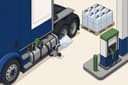 Diesel exhaust fluid and other nitrogen productsThe catch-all line: 2.1 million tons at $262 in 2025, led by the fluid diesel trucks burn to clean their exhaust — management's highest-margin product in the first half of 2026. Orders arrive all year, not in a spring rush.
The catch-all line: 2.1 million tons at $262 in 2025, led by the fluid diesel trucks burn to clean their exhaust — management's highest-margin product in the first half of 2026. Orders arrive all year, not in a spring rush.
In plain English
Modern diesel trucks carry a second, smaller tank beside the fuel tank. It holds a clear liquid made from urea, sprayed into the hot exhaust to clean it before it leaves the pipe. Every truck running drinks the stuff continuously, so orders arrive in every week of the year rather than in the planting rush.
Alongside it sit a few industrial cousins — urea liquor, nitric acid, aqua ammonia — sold to factories. Management called diesel fluid its highest-margin product, put first-half volumes at its second-highest ever, and puts North American demand at a bit over two million tons of urea a year, heading past three by the end of the decade.
Competes with Air1 DEF (Yara International) · DEF and industrial nitrogen (LSB Industries) · Nitric acid and nitrates (Nutrien)
 AN (ammonium nitrate)Ammonium nitrate for farms and for blasting rock — $421 million in 2025, until a November incident took down the complex management calls its only plant for the solution form. Quarterly sales fell by roughly a third; restart has slipped to the first half of 2027.
Ammonium nitrate for farms and for blasting rock — $421 million in 2025, until a November incident took down the complex management calls its only plant for the solution form. Quarterly sales fell by roughly a third; restart has slipped to the first half of 2027.
In plain English
A solid, fast-acting form of nitrogen. Farmers in Britain and Europe spread it on fields; miners mix it to blast rock apart.
This is the piece of CF that is currently out of action. An incident in November 2025 shut the whole Yazoo City complex in Mississippi, and it has not run since. Insurance has paid about $75 million so far; even so, the outage costs roughly $200 million of earnings in 2026, and restart has moved from late 2026 to the first half of 2027 while CF waits on electrical gear. The rebuilt plant comes back making the liquid form, ammonia and diesel fluid — not the pellets it used to.
Competes with High-density ammonium nitrate (LSB Industries) · Nitrates (Nutrien) · European AN (Yara International)
Named in filings, launches and programs
- CHS Inc.Customer programThe farm cooperative that was CF's biggest customer, about 13% of 2025 sales, with rights to buy set tonnages of urea and UAN at market prices.
- Donaldsonville ComplexBrandThe Louisiana flagship and largest single site; its carbon capture unit, started in July 2025, is what makes the low-carbon tons possible.
- Yazoo City ComplexBrand · AnnouncedThe Mississippi plant knocked out in November 2025; the rebuild targets the first half of 2027 and will make liquid nitrate, ammonia and diesel fluid.
- Waggaman ComplexBrandA bought-in plant CF has pushed from 750,000 to over 900,000 tons of ammonia a year — by more than 30%, per management.
- Billingham ComplexBrandAmmonia making stopped here in September 2022; the UK site now buys ammonia in and upgrades it, European gas having run far dearer than American.
- Point Lisas NitrogenBrandA 50/50 Trinidad venture with Koch Fertilizer, 720,000 tons of ammonia a year on local gas; its results sit outside CF's reported sales.
- Medicine Hat, Verdigris, Port Neal, Woodward and Courtright complexesBrandThe rest of the plant fleet, which with the flagship sites makes up roughly ten and a half million tons a year of ammonia capacity.
- Courtright DEF upgrade projectProduct · AnnouncedAn engineering study into making more diesel exhaust fluid. Not approved, not funded, and deliberately left out of management's 2030 earnings promise.
- PepsiCo low-carbon UAN programCustomer programCertified low-carbon liquid fertilizer going onto the US potatoes behind Frito-Lay brands — a food company paying for a cleaner ingredient upstream.
- POET low-carbon fertilizer pilotCustomer programA trial with POET and farm cooperatives to cut the carbon intensity of ethanol, the fuel made from crops.
- Verified Ammonia Carbon Intensity (VACI)EcosystemThe certification scheme that stamps a ton of CF ammonia as low-carbon. Without the stamp there is no premium to charge.
CHS Inc.Customer program
The farm cooperative that was CF's biggest customer, about 13% of 2025 sales, with rights to buy set tonnages of urea and UAN at market prices.
Donaldsonville ComplexBrand
The Louisiana flagship and largest single site; its carbon capture unit, started in July 2025, is what makes the low-carbon tons possible.
Yazoo City ComplexBrand · Announced
The Mississippi plant knocked out in November 2025; the rebuild targets the first half of 2027 and will make liquid nitrate, ammonia and diesel fluid.
Waggaman ComplexBrand
A bought-in plant CF has pushed from 750,000 to over 900,000 tons of ammonia a year — by more than 30%, per management.
Billingham ComplexBrand
Ammonia making stopped here in September 2022; the UK site now buys ammonia in and upgrades it, European gas having run far dearer than American.
Point Lisas NitrogenBrand
A 50/50 Trinidad venture with Koch Fertilizer, 720,000 tons of ammonia a year on local gas; its results sit outside CF's reported sales.
Medicine Hat, Verdigris, Port Neal, Woodward and Courtright complexesBrand
The rest of the plant fleet, which with the flagship sites makes up roughly ten and a half million tons a year of ammonia capacity.
Courtright DEF upgrade projectProduct · Announced
An engineering study into making more diesel exhaust fluid. Not approved, not funded, and deliberately left out of management's 2030 earnings promise.
PepsiCo low-carbon UAN programCustomer program
Certified low-carbon liquid fertilizer going onto the US potatoes behind Frito-Lay brands — a food company paying for a cleaner ingredient upstream.
POET low-carbon fertilizer pilotCustomer program
A trial with POET and farm cooperatives to cut the carbon intensity of ethanol, the fuel made from crops.
Verified Ammonia Carbon Intensity (VACI)Ecosystem
The certification scheme that stamps a ton of CF ammonia as low-carbon. Without the stamp there is no premium to charge.