
FTAI (FTAI)
Links aircraft and engine leasing with modular commercial-engine repair and aftermarket products.
Something off on this page? Send us feedback.
FTAI buys tired jet engines, pulls them apart and sells the good sections back to airlines as a ready replacement, sparing them a months-long overhaul. Around that trade it has added two newer businesses: investment funds that own the aircraft while FTAI keeps their engines turning, and generators built from the same engine cores for buyers who need power fast. The rebuilt engines pay for everything; the generators are the wager.
Item facts: H1 2026 · six months ended June 30, 2026, from filings, earnings calls and company pages.
Judgment weights, not filed revenue
The band summarizes business focus and direction. ~ marks estimates.
7 in detail · 11 more below
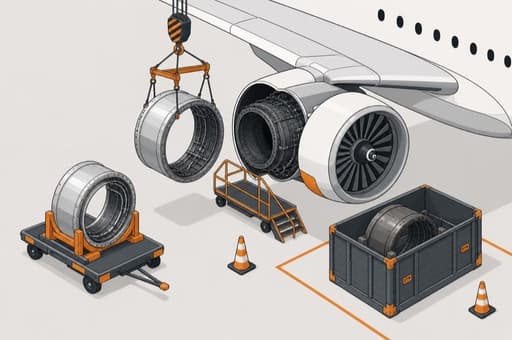
CFM56 & V2500 module exchange
The core trade: buy run-out jet engines cheaply, rebuild the good sections and hand an airline a ready replacement instead of a four-to-five-month overhaul. Guided to 1,200 modules this year against 757 last year, with prices cut to win big airline accounts.
Competes with CFM56 performance restoration (CFM International) · CFM56 engine overhaul (MTU Aero Engines) · CFM56 engine overhaul (StandardAero)
In plain English
A jet engine is not one lump. It comes apart into a few big sections, and usually only one of them is worn out. FTAI buys whole tired engines — three of them cost about six and a half million dollars, by the company's own worked example — splits them into sections, refurbishes the good ones and sells them singly or bolted back together.
An airline whose engine is due would otherwise hand it to a repair shop for four to five months and a bill of roughly two to three million dollars. FTAI offers a rebuilt section off its own shelf instead, priced against that bill rather than against the parts inside it.
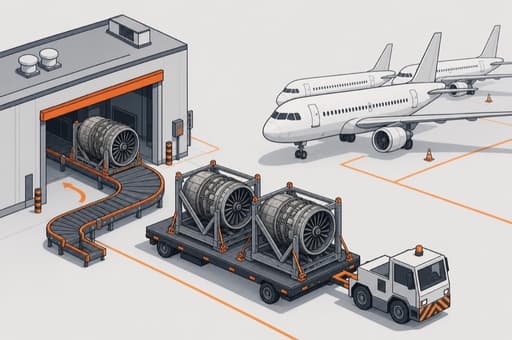
Maintenance, Repair & Exchange agreement
FTAI promises the aircraft funds it sponsors that it will supply their engines and take the worn ones back. That brought in $404M in the first half, but it steps up with each new fund rather than growing, and it sagged last quarter between funds.
Competes with AASET funds' open-market engine buying (Carlyle Aviation) · CLAS funds' open-market engine buying (Castlelake)
In plain English
Picture a landlord who also owns the only boiler company in town and writes into every lease that the boilers come from them.
FTAI raises investment funds that buy mid-life airliners, and the paperwork commits those funds to buy their serviceable engines from FTAI and hand the worn ones back. Every aircraft a fund buys carries two engines committed this way, so money raised from investors turns into engine sales. Two customers were 30% and 20% of the whole company's sales last quarter; the smaller of the two lines up with these funds. When one fund finishes buying and the next has not started, the line sags.
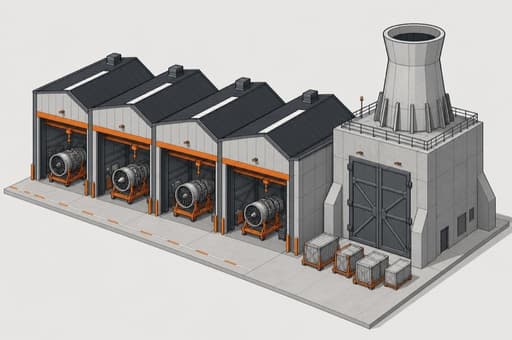
Engine shops — Montréal, Miami, Rome, Lisbon
Four shops plus partner capacity turn bought engines into sellable sections. Montréal — the former Lockheed Martin plant, bought for $170M — can handle up to 900 modules a year, and the network could do about 3,000 against 1,200 planned. Licensed mechanics, not floor space, set the pace.
Competes with CFM56 shop network (GE Aerospace) · CFM56 engine maintenance (Lufthansa Technik)
In plain English
The unglamorous part that makes the rest possible. Somebody has to take the engines apart, clean and inspect every piece, reassemble the good sections and run them on a test stand before an airline will fly behind them.
FTAI owns that work rather than buying it in: a large plant in Montréal bought from Lockheed Martin, a shop in Miami, a half-owned joint venture in Rome with IAG's engine arm, a site in Lisbon, and newer partner shops in Jakarta and Cairo it does not own. The shops sell nothing on their own — their output is what the sales lines sell. The limit management names is licensed mechanics, not buildings.
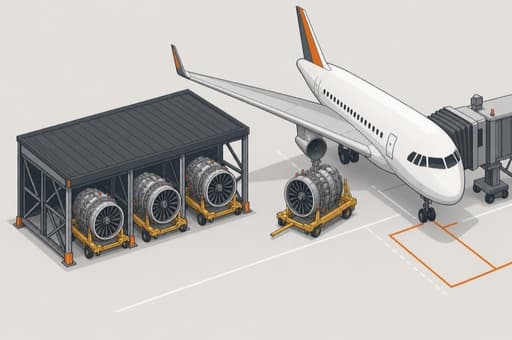
Perpetual Power engine exchanges
Airlines such as LATAM and Finnair sign multi-year deals guaranteeing them a serviceable engine on exchange whenever one comes due; Finnair committed its whole fleet, 36 engines. Large dollars per contract, thinner margins than selling the same hardware once.
Competes with ConstantThrust engine exchange (Willis Lease Finance) · Rate-per-flight-hour engine contracts (CFM International)
In plain English
Instead of keeping a spare engine for the day one fails, an airline can buy the certainty. Under these agreements FTAI keeps serviceable CFM56 and V2500 engines available and swaps one in whenever an airline's engine comes due, for years at a stretch — Finnair signed up its whole fleet, thirty-six engines; LATAM signed earlier.
The airline gets aircraft that keep flying instead of sitting in a shop queue. FTAI gets a long, predictable claim on its own engine pool, at prices that are large in dollars but thinner in margin than selling the same hardware once to whoever calls.
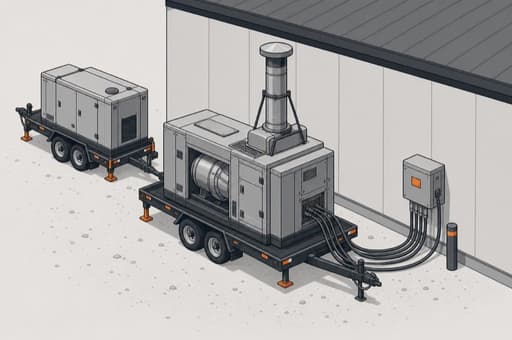
FTAI Power — Mod-1 turbine
A CFM56 jet-engine core rebuilt as a 25-megawatt generator, with first deliveries guided to late this year. One unnamed cloud company has ordered $1.465B of them for 2027, and the first 2027 guidance pencils in $450M of earnings from a line that has sold nothing yet.
Competes with PE6000 power blocks (ProEnergy) · TM2500 mobile turbine packages (GE Vernova) · Industrial turbines 1–39 MW (Caterpillar)
In plain English
Electricity buyers want power sooner than the big turbine makers can deliver; those makers are booked into the end of the decade.
FTAI's answer is to take the same engine core it already rebuilds for aircraft, mount it in a truck-sized package with a generator, gearbox and controls, and sell a 25-megawatt power station that arrives on a trailer and can be swapped in place in two days. The packaging runs through J&F Power Systems, a venture with China's Jereh Group. A cloud company FTAI has not named placed a $1.465B first order for delivery through late 2027, paying at signing and at milestones — which is also helping fund the build-out.
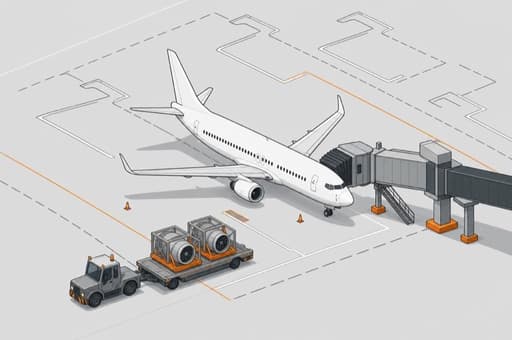
Aviation Leasing — owned aircraft and engines
The company's old engine: 290 owned aircraft and spare engines at the end of last year, rented to airlines. First-half revenue fell 53% as aircraft moved into the managed funds and rebuilt sections went to outside buyers instead. Guidance suggests the shrinking is nearly done.
Competes with Narrowbody lease portfolio (AerCap) · Narrowbody lease portfolio (Air Lease) · Spare-engine leasing (Willis Lease Finance)
In plain English
Before the rebuilding business took over, this was the company: buy narrowbody jets and spare engines, rent them to airlines, collect the rent plus maintenance payments, sell the asset on at the end.
It is getting smaller on purpose. The aircraft are being sold into the investment funds FTAI now runs, and the rebuilt engine sections that once kept this fleet flying are worth more sold to outsiders. Its job now is to throw off cash: selling assets brought in $1.72B last year, which covered the year's building and buying. Eight aircraft and seventeen engines remain stuck in Russia.
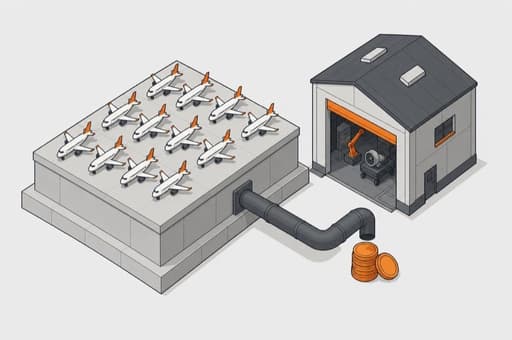
Strategic Capital
Big investors put up the money, FTAI picks the aircraft and runs them for a fee of one percent or more of the assets. The first fund raised $2B of equity in ten months and bought 300-plus aircraft — each one bringing two engines committed to FTAI's shops.
Competes with Willis Aviation Capital (Willis Lease Finance) · AASET aircraft funds (Carlyle Aviation) · CLAS aircraft funds (Castlelake)
In plain English
Big investors want a steady return from aircraft; FTAI wants more engines moving through its shops. These funds solve both at once.
FTAI sets up investment vehicles that buy already-leased 737s and A320s, puts in some of its own money alongside — nineteen percent of the first one, fifteen percent of the second — and manages them for a fee of one percent or more of what the fund owns. The first fund raised two billion dollars of equity in ten months and committed about six billion across more than three hundred aircraft; fees and FTAI's own share of the returns were $35M of the $88.2M the leasing side earned last quarter. A second fund started this year, targeting a $6B raise.


 CFM56 & V2500 module exchangeThe core trade: buy run-out jet engines cheaply, rebuild the good sections and hand an airline a ready replacement instead of a four-to-five-month overhaul. Guided to 1,200 modules this year against 757 last year, with prices cut to win big airline accounts.
The core trade: buy run-out jet engines cheaply, rebuild the good sections and hand an airline a ready replacement instead of a four-to-five-month overhaul. Guided to 1,200 modules this year against 757 last year, with prices cut to win big airline accounts.
In plain English
A jet engine is not one lump. It comes apart into a few big sections, and usually only one of them is worn out. FTAI buys whole tired engines — three of them cost about six and a half million dollars, by the company's own worked example — splits them into sections, refurbishes the good ones and sells them singly or bolted back together.
An airline whose engine is due would otherwise hand it to a repair shop for four to five months and a bill of roughly two to three million dollars. FTAI offers a rebuilt section off its own shelf instead, priced against that bill rather than against the parts inside it.
Competes with CFM56 performance restoration (CFM International) · CFM56 engine overhaul (MTU Aero Engines) · CFM56 engine overhaul (StandardAero)
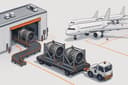 Maintenance, Repair & Exchange agreementFTAI promises the aircraft funds it sponsors that it will supply their engines and take the worn ones back. That brought in $404M in the first half, but it steps up with each new fund rather than growing, and it sagged last quarter between funds.
FTAI promises the aircraft funds it sponsors that it will supply their engines and take the worn ones back. That brought in $404M in the first half, but it steps up with each new fund rather than growing, and it sagged last quarter between funds.
In plain English
Picture a landlord who also owns the only boiler company in town and writes into every lease that the boilers come from them.
FTAI raises investment funds that buy mid-life airliners, and the paperwork commits those funds to buy their serviceable engines from FTAI and hand the worn ones back. Every aircraft a fund buys carries two engines committed this way, so money raised from investors turns into engine sales. Two customers were 30% and 20% of the whole company's sales last quarter; the smaller of the two lines up with these funds. When one fund finishes buying and the next has not started, the line sags.
Competes with AASET funds' open-market engine buying (Carlyle Aviation) · CLAS funds' open-market engine buying (Castlelake)
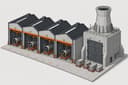 Engine shops — Montréal, Miami, Rome, LisbonFour shops plus partner capacity turn bought engines into sellable sections. Montréal — the former Lockheed Martin plant, bought for $170M — can handle up to 900 modules a year, and the network could do about 3,000 against 1,200 planned. Licensed mechanics, not floor space, set the pace.
Four shops plus partner capacity turn bought engines into sellable sections. Montréal — the former Lockheed Martin plant, bought for $170M — can handle up to 900 modules a year, and the network could do about 3,000 against 1,200 planned. Licensed mechanics, not floor space, set the pace.
In plain English
The unglamorous part that makes the rest possible. Somebody has to take the engines apart, clean and inspect every piece, reassemble the good sections and run them on a test stand before an airline will fly behind them.
FTAI owns that work rather than buying it in: a large plant in Montréal bought from Lockheed Martin, a shop in Miami, a half-owned joint venture in Rome with IAG's engine arm, a site in Lisbon, and newer partner shops in Jakarta and Cairo it does not own. The shops sell nothing on their own — their output is what the sales lines sell. The limit management names is licensed mechanics, not buildings.
Competes with CFM56 shop network (GE Aerospace) · CFM56 engine maintenance (Lufthansa Technik)
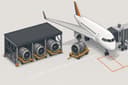 Perpetual Power engine exchangesAirlines such as LATAM and Finnair sign multi-year deals guaranteeing them a serviceable engine on exchange whenever one comes due; Finnair committed its whole fleet, 36 engines. Large dollars per contract, thinner margins than selling the same hardware once.
Airlines such as LATAM and Finnair sign multi-year deals guaranteeing them a serviceable engine on exchange whenever one comes due; Finnair committed its whole fleet, 36 engines. Large dollars per contract, thinner margins than selling the same hardware once.
In plain English
Instead of keeping a spare engine for the day one fails, an airline can buy the certainty. Under these agreements FTAI keeps serviceable CFM56 and V2500 engines available and swaps one in whenever an airline's engine comes due, for years at a stretch — Finnair signed up its whole fleet, thirty-six engines; LATAM signed earlier.
The airline gets aircraft that keep flying instead of sitting in a shop queue. FTAI gets a long, predictable claim on its own engine pool, at prices that are large in dollars but thinner in margin than selling the same hardware once to whoever calls.
Competes with ConstantThrust engine exchange (Willis Lease Finance) · Rate-per-flight-hour engine contracts (CFM International)
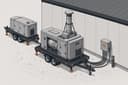 FTAI Power — Mod-1 turbineA CFM56 jet-engine core rebuilt as a 25-megawatt generator, with first deliveries guided to late this year. One unnamed cloud company has ordered $1.465B of them for 2027, and the first 2027 guidance pencils in $450M of earnings from a line that has sold nothing yet.
A CFM56 jet-engine core rebuilt as a 25-megawatt generator, with first deliveries guided to late this year. One unnamed cloud company has ordered $1.465B of them for 2027, and the first 2027 guidance pencils in $450M of earnings from a line that has sold nothing yet.
In plain English
Electricity buyers want power sooner than the big turbine makers can deliver; those makers are booked into the end of the decade.
FTAI's answer is to take the same engine core it already rebuilds for aircraft, mount it in a truck-sized package with a generator, gearbox and controls, and sell a 25-megawatt power station that arrives on a trailer and can be swapped in place in two days. The packaging runs through J&F Power Systems, a venture with China's Jereh Group. A cloud company FTAI has not named placed a $1.465B first order for delivery through late 2027, paying at signing and at milestones — which is also helping fund the build-out.
Competes with PE6000 power blocks (ProEnergy) · TM2500 mobile turbine packages (GE Vernova) · Industrial turbines 1–39 MW (Caterpillar)
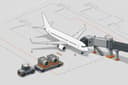 Aviation Leasing — owned aircraft and enginesThe company's old engine: 290 owned aircraft and spare engines at the end of last year, rented to airlines. First-half revenue fell 53% as aircraft moved into the managed funds and rebuilt sections went to outside buyers instead. Guidance suggests the shrinking is nearly done.
The company's old engine: 290 owned aircraft and spare engines at the end of last year, rented to airlines. First-half revenue fell 53% as aircraft moved into the managed funds and rebuilt sections went to outside buyers instead. Guidance suggests the shrinking is nearly done.
In plain English
Before the rebuilding business took over, this was the company: buy narrowbody jets and spare engines, rent them to airlines, collect the rent plus maintenance payments, sell the asset on at the end.
It is getting smaller on purpose. The aircraft are being sold into the investment funds FTAI now runs, and the rebuilt engine sections that once kept this fleet flying are worth more sold to outsiders. Its job now is to throw off cash: selling assets brought in $1.72B last year, which covered the year's building and buying. Eight aircraft and seventeen engines remain stuck in Russia.
Competes with Narrowbody lease portfolio (AerCap) · Narrowbody lease portfolio (Air Lease) · Spare-engine leasing (Willis Lease Finance)
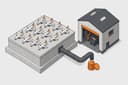 Strategic CapitalBig investors put up the money, FTAI picks the aircraft and runs them for a fee of one percent or more of the assets. The first fund raised $2B of equity in ten months and bought 300-plus aircraft — each one bringing two engines committed to FTAI's shops.
Big investors put up the money, FTAI picks the aircraft and runs them for a fee of one percent or more of the assets. The first fund raised $2B of equity in ten months and bought 300-plus aircraft — each one bringing two engines committed to FTAI's shops.
In plain English
Big investors want a steady return from aircraft; FTAI wants more engines moving through its shops. These funds solve both at once.
FTAI sets up investment vehicles that buy already-leased 737s and A320s, puts in some of its own money alongside — nineteen percent of the first one, fifteen percent of the second — and manages them for a fee of one percent or more of what the fund owns. The first fund raised two billion dollars of equity in ten months and committed about six billion across more than three hundred aircraft; fees and FTAI's own share of the returns were $35M of the $88.2M the leasing side earned last quarter. A second fund started this year, targeting a $6B raise.
Competes with Willis Aviation Capital (Willis Lease Finance) · AASET aircraft funds (Carlyle Aviation) · CLAS aircraft funds (Castlelake)
Named in filings, launches and programs
- PMA parts program (Chromalloy)Product · RampingFive copies of CFM56 hot-section parts made with Chromalloy, three approved so far; fully approved they cut about $2M from the cost of a shop visit.
- V2500 lineProduct lineThe second engine family alongside the CFM56, worked the same way — consistently the smaller of the two in management's telling.
- AEI 737-800 freighter collaborationCustomer program · AnnouncedFTAI buys mid-life 737-800s and AEI conversion kits; the jets are rebuilt as freighters with FTAI engines and sold on or into the funds.
- Prime Engine AccessoriesBrandA 50-50 venture with Bauer in Connecticut making fuel pumps, valves and actuators in-house; about $10M invested, targeting roughly $75,000 saved per shop visit.
- Pacific AerodynamicBrandCalifornia component-repair business bought in 2025 for about $15M; credited with one to two points of margin.
- ATOPSBrandMiami engine-repair business agreed in 2025 for about $15M, bolted onto the QuickTurn Miami shop.
- GMF AeroAsia and EgyptAir shop partnershipsEcosystem · AnnouncedPartner shops in Jakarta and Cairo that FTAI does not own, added in 2026 to stretch capacity; GMF is majority owned by Garuda Group, itself a customer.
- Palantir partnershipEcosystemSince late 2025 Palantir's software has been used across the shops to plan supply and cut downtime.
- LEAP maintenance build-outProduct · Pre-revenueA new Rome test cell built to handle LEAP engines as well as CFM56s — no revenue yet, and talked about far more in the latest quarter.
- Montréal Training AcademyServiceIn-house school for mechanics, aimed straight at the shortage of licensed hands that caps how many engines the shops can finish.
- J&F Power SystemsBrandThe venture with China's Jereh Group that packages the turbine — trailer, generator, gearbox, controls — and holds the five-year supply deal behind the first order.
PMA parts program (Chromalloy)Product · Ramping
Five copies of CFM56 hot-section parts made with Chromalloy, three approved so far; fully approved they cut about $2M from the cost of a shop visit.
V2500 lineProduct line
The second engine family alongside the CFM56, worked the same way — consistently the smaller of the two in management's telling.
AEI 737-800 freighter collaborationCustomer program · Announced
FTAI buys mid-life 737-800s and AEI conversion kits; the jets are rebuilt as freighters with FTAI engines and sold on or into the funds.
Prime Engine AccessoriesBrand
A 50-50 venture with Bauer in Connecticut making fuel pumps, valves and actuators in-house; about $10M invested, targeting roughly $75,000 saved per shop visit.
Pacific AerodynamicBrand
California component-repair business bought in 2025 for about $15M; credited with one to two points of margin.
ATOPSBrand
Miami engine-repair business agreed in 2025 for about $15M, bolted onto the QuickTurn Miami shop.
GMF AeroAsia and EgyptAir shop partnershipsEcosystem · Announced
Partner shops in Jakarta and Cairo that FTAI does not own, added in 2026 to stretch capacity; GMF is majority owned by Garuda Group, itself a customer.
Palantir partnershipEcosystem
Since late 2025 Palantir's software has been used across the shops to plan supply and cut downtime.
LEAP maintenance build-outProduct · Pre-revenue
A new Rome test cell built to handle LEAP engines as well as CFM56s — no revenue yet, and talked about far more in the latest quarter.
Montréal Training AcademyService
In-house school for mechanics, aimed straight at the shortage of licensed hands that caps how many engines the shops can finish.
J&F Power SystemsBrand
The venture with China's Jereh Group that packages the turbine — trailer, generator, gearbox, controls — and holds the five-year supply deal behind the first order.