
GE HealthCare (GEHC)
Makes medical imaging systems, diagnostic agents, patient monitors, and related software and services.
Something off on this page? Send us feedback.
GE HealthCare builds the machines hospitals look inside patients with, then earns for years off each one — servicing it, updating its software, and selling the injected dyes every scan consumes. Spun out of General Electric, it is pairing those machines with drugs and software so more of the money arrives as repeat business. The scanners bring in most of the sales; the supplies and the service carry the better margins.
Item facts: FY2025 · year ended Dec 31, 2025, from filings, earnings calls and company pages.
Judgment weights, not filed revenue
The band summarizes business focus and direction. ~ marks estimates.
8 in detail · 12 more below
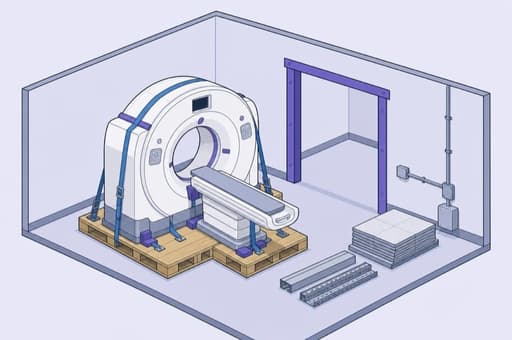
CT and MR scanners (Revolution, Photonova Spectra, SIGNA)
The two machines hospitals plan whole rooms around, and the company's biggest slice of sales. The imaging division they sit in earned only about ten cents of operating profit per dollar last year, and a new photon-counting scanner, Photonova Spectra, is barely in the order book yet.
Competes with Naeotom Alpha photon-counting CT (Siemens Healthineers) · Magnetom MR (Siemens Healthineers) · Ingenia MR / Incisive CT (Philips)
In plain English
A CT scanner spins X-rays around a patient and builds the picture in slices; an MR machine does a similar job with a huge magnet and no X-rays at all. Each one costs from half a million to several million dollars and needs its own purpose-built room.
Hospitals buy them the way a bus company buys buses — rarely, on a long replacement cycle, then run them for a decade or more. GE HealthCare gets paid once for the machine and again every year afterwards to keep it working. Tariffs and higher part costs have been eating into what it keeps on each sale.
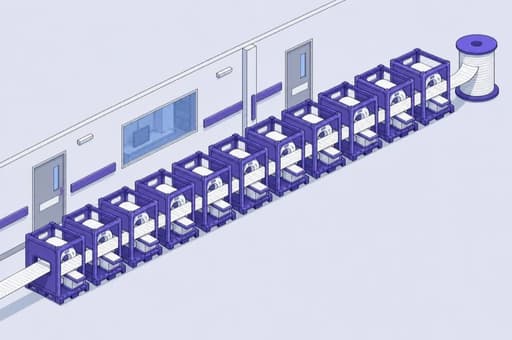
Service contracts and Care Alliance agreements
Fixing, updating and stocking the machines after they are sold. More than 45% of revenue was this kind of repeat money back in 2024, and orders signed but not yet delivered hit a record $23.9 billion by mid-2026. No hospital customer comes near a tenth of sales.
Competes with Value Partnerships (Siemens Healthineers) · Long-term Strategic Partnerships (Philips) · Multivendor equipment service (Agiliti)
In plain English
Every scanner in a hospital has a second life as a subscription. GE HealthCare's engineers keep it running, its software gets updated, and the hospital pays year after year — money that arrives whether or not anyone buys a new machine.
Care Alliance is the larger version of the same idea: a hospital system agrees to standardise on GE HealthCare for a decade or more and takes equipment, software and service as one package. Catholic Health signed one in 2026 — about $500 million over ten years, covering more than forty of its sites.
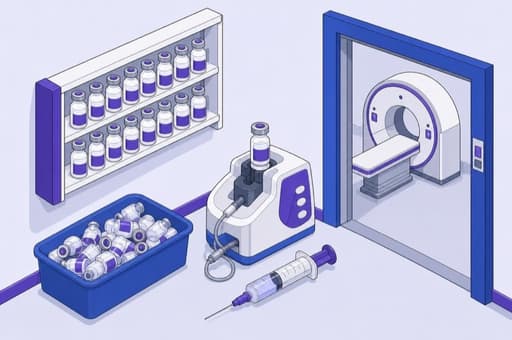
Contrast media (Omnipaque, Visipaque, Clariscan, Pixxoscan, Optison)
Injected liquids that make vessels and organs stand out on a scan — about a tenth of sales, reordered every time one of those scans happens. Margins here run far above the hardware's. A supplier recall in early 2026 dented profit and the year's guidance.
Competes with Ultravist / Gadavist (Bayer) · Isovue / ProHance (Bracco Imaging) · Xenetix / Dotarem (Guerbet)
In plain English
Think of it as highlighter fluid for the body: before many scans the patient is injected with a liquid that makes vessels and organs show up sharply — an iodine-based kind for CT and X-ray, a different kind for MR machines, and another for heart ultrasound.
One dose per scan, one payment per dose. Because GE HealthCare put many of those scanners in the rooms in the first place, the dyes ride along on machines it already sold, and sales rise with how often patients are scanned rather than with hospital building budgets. The catch is supply: some ingredients come from a single source.
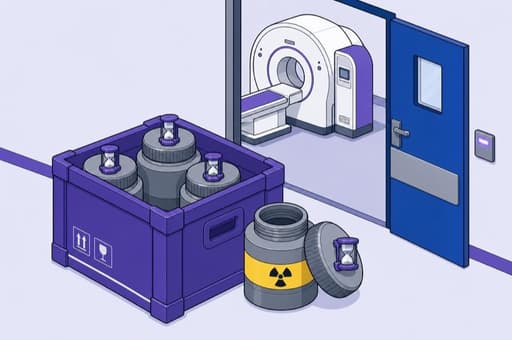
Molecular imaging and radiopharmaceuticals (Omni Legend, StarGuide GX, Flyrcado)
Here GE HealthCare sells both the scanner and the short-lived radioactive dose injected into it. Flyrcado, its heart dose, is the bet management keeps repeating: $500 million or more a year by 2028, from a few hundred doses a week across a few dozen sites in spring 2026.
Competes with CardioGen-82 rubidium generator (Bracco) · RUBY-FILL rubidium generator (Jubilant DraxImage) · Amyvid amyloid PET agent (Eli Lilly)
In plain English
Some scans run the other way around. Instead of sending something through the patient, the hospital injects a tiny radioactive dose and the machine watches where it travels — which is how a doctor sees whether heart muscle is getting enough blood. GE HealthCare makes both halves, the machine and the dose.
The dose is the awkward, valuable part, because it starts fading the moment it is made. Flyrcado stays usable for roughly a couple of hours, long enough to get it from where it is made to a hospital, where the older rival doses fade in about a minute. Every patient scanned is one more dose sold.
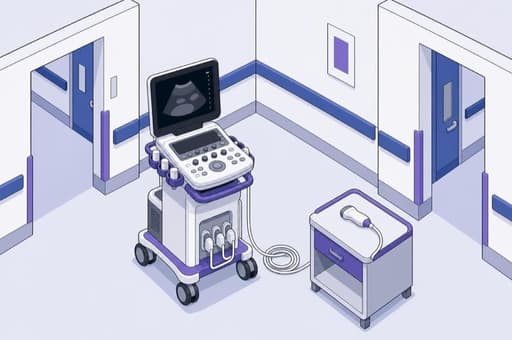
Ultrasound (Vivid, LOGIQ, Voluson, Venue, Invenia ABUS)
Wheeled carts and handheld probes for hearts, pregnancies, emergency rooms and breast screening — roughly $18 of every $100 of sales. Cheaper than a scanner and quicker to deliver, so orders turn into revenue faster. Mindray keeps winning business on price in emerging markets.
Competes with EPIQ / Lumify (Philips) · Acuson ultrasound family (Siemens Healthineers) · Resona / TE series (Mindray)
In plain English
The machine most people have actually seen: a probe smeared with gel, slid across skin, and a grainy live picture on a screen at the bedside. Sound waves bounce back off tissue and software turns the echoes into a moving image.
GE HealthCare sells a whole family of them — Vivid for hearts, Voluson for pregnancy, LOGIQ for general radiology, Venue for emergency departments, Invenia for automated breast screening. They cost far less than a scanner, and an order turns into a delivered, working machine much sooner. Then the department comes back for the next generation.
Patient Care Solutions
The bedside kit — vital-signs monitors, anesthesia machines, maternal and newborn equipment, ECG carts. It was 15.0% of sales last year and is shrinking: down about 13.5% in the June 2026 quarter and losing money. Orders still grew, so it is a building-and-shipping problem.
Competes with IntelliVue monitoring (Philips) · BeneVision monitoring (Mindray) · Perseus / Atlan anesthesia workstations (Dräger)
In plain English
Not the scanners — the machines around the bed. The screen tracking a patient's heartbeat and oxygen, the trolley that delivers anesthesia in an operating room, the equipment used in labour and delivery, the cart that records a heart tracing. Same hospitals, different departments.
Right now this is the problem child. Demand held up — orders grew through the first half of 2026 — but GE HealthCare could not build and ship fast enough, sales fell for several quarters running, and the unit slipped into a loss. Management has put it under review, up to and including selling it, with no deadline set.
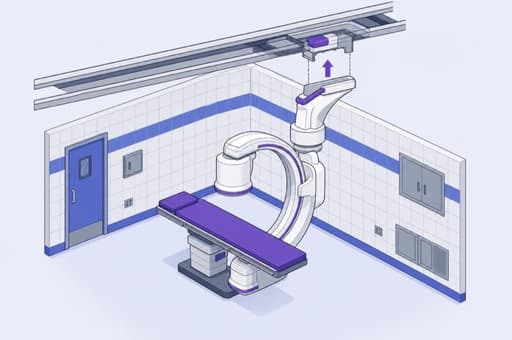
Image-Guided Therapies (Allia IGS)
X-ray rooms that let a doctor watch a thin tube travel through a patient's blood vessels while the repair is happening — roughly $8 of every $100 of sales. In 2026 GE HealthCare added ways to modernise old rooms without rebuilding them.
Competes with Azurion image-guided therapy (Philips) · Artis icono angiography (Siemens Healthineers) · Alphenix (Canon Medical)
In plain English
A different kind of room. Instead of taking one picture and sending the patient home, the X-ray equipment keeps watching while a doctor threads a thin tube through a blood vessel to open or repair it. The live picture is the doctor's eyesight.
GE HealthCare sells the whole room under the Allia name, and named this area as one of the things pulling growth along in 2026. Because a brand-new room means construction work, it now also sells upgrades that slot new equipment into rooms fitted out years ago — a quicker sale for GE HealthCare, and no building work for the hospital.
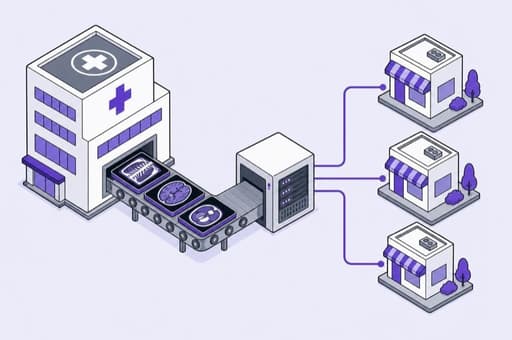
Enterprise imaging software and AI (Intelerad, MIM Software, CareIntellect)
The software layer: storing scans, moving them between sites, and AI that sharpens images or flags what to look at. Small today, but GE HealthCare paid a $2.3 billion base price for Intelerad in 2026 to reach imaging centres outside hospital walls.
Competes with Sectra PACS (Sectra) · Visage 7 (Pro Medicus) · Merge PACS (Merative)
In plain English
Each scan produces a file that somebody has to keep, move and open. That plumbing is a business of its own: hospitals and imaging clinics pay a recurring fee for software that stores the pictures safely and puts them on the right doctor's screen.
GE HealthCare has been buying its way in. Intelerad, whose system does that storing and sharing over the internet rather than on machines in the basement, cost a $2.3 billion base price and closed in March 2026; the company says it will barely move profit this year. Sectra, a specialist rival, keeps ranking first in independent hospital ratings.


 CT and MR scanners (Revolution, Photonova Spectra, SIGNA)The two machines hospitals plan whole rooms around, and the company's biggest slice of sales. The imaging division they sit in earned only about ten cents of operating profit per dollar last year, and a new photon-counting scanner, Photonova Spectra, is barely in the order book yet.
The two machines hospitals plan whole rooms around, and the company's biggest slice of sales. The imaging division they sit in earned only about ten cents of operating profit per dollar last year, and a new photon-counting scanner, Photonova Spectra, is barely in the order book yet.
In plain English
A CT scanner spins X-rays around a patient and builds the picture in slices; an MR machine does a similar job with a huge magnet and no X-rays at all. Each one costs from half a million to several million dollars and needs its own purpose-built room.
Hospitals buy them the way a bus company buys buses — rarely, on a long replacement cycle, then run them for a decade or more. GE HealthCare gets paid once for the machine and again every year afterwards to keep it working. Tariffs and higher part costs have been eating into what it keeps on each sale.
Competes with Naeotom Alpha photon-counting CT (Siemens Healthineers) · Magnetom MR (Siemens Healthineers) · Ingenia MR / Incisive CT (Philips)
 Service contracts and Care Alliance agreementsFixing, updating and stocking the machines after they are sold. More than 45% of revenue was this kind of repeat money back in 2024, and orders signed but not yet delivered hit a record $23.9 billion by mid-2026. No hospital customer comes near a tenth of sales.
Fixing, updating and stocking the machines after they are sold. More than 45% of revenue was this kind of repeat money back in 2024, and orders signed but not yet delivered hit a record $23.9 billion by mid-2026. No hospital customer comes near a tenth of sales.
In plain English
Every scanner in a hospital has a second life as a subscription. GE HealthCare's engineers keep it running, its software gets updated, and the hospital pays year after year — money that arrives whether or not anyone buys a new machine.
Care Alliance is the larger version of the same idea: a hospital system agrees to standardise on GE HealthCare for a decade or more and takes equipment, software and service as one package. Catholic Health signed one in 2026 — about $500 million over ten years, covering more than forty of its sites.
Competes with Value Partnerships (Siemens Healthineers) · Long-term Strategic Partnerships (Philips) · Multivendor equipment service (Agiliti)
 Contrast media (Omnipaque, Visipaque, Clariscan, Pixxoscan, Optison)Injected liquids that make vessels and organs stand out on a scan — about a tenth of sales, reordered every time one of those scans happens. Margins here run far above the hardware's. A supplier recall in early 2026 dented profit and the year's guidance.
Injected liquids that make vessels and organs stand out on a scan — about a tenth of sales, reordered every time one of those scans happens. Margins here run far above the hardware's. A supplier recall in early 2026 dented profit and the year's guidance.
In plain English
Think of it as highlighter fluid for the body: before many scans the patient is injected with a liquid that makes vessels and organs show up sharply — an iodine-based kind for CT and X-ray, a different kind for MR machines, and another for heart ultrasound.
One dose per scan, one payment per dose. Because GE HealthCare put many of those scanners in the rooms in the first place, the dyes ride along on machines it already sold, and sales rise with how often patients are scanned rather than with hospital building budgets. The catch is supply: some ingredients come from a single source.
Competes with Ultravist / Gadavist (Bayer) · Isovue / ProHance (Bracco Imaging) · Xenetix / Dotarem (Guerbet)
 Molecular imaging and radiopharmaceuticals (Omni Legend, StarGuide GX, Flyrcado)Here GE HealthCare sells both the scanner and the short-lived radioactive dose injected into it. Flyrcado, its heart dose, is the bet management keeps repeating: $500 million or more a year by 2028, from a few hundred doses a week across a few dozen sites in spring 2026.
Here GE HealthCare sells both the scanner and the short-lived radioactive dose injected into it. Flyrcado, its heart dose, is the bet management keeps repeating: $500 million or more a year by 2028, from a few hundred doses a week across a few dozen sites in spring 2026.
In plain English
Some scans run the other way around. Instead of sending something through the patient, the hospital injects a tiny radioactive dose and the machine watches where it travels — which is how a doctor sees whether heart muscle is getting enough blood. GE HealthCare makes both halves, the machine and the dose.
The dose is the awkward, valuable part, because it starts fading the moment it is made. Flyrcado stays usable for roughly a couple of hours, long enough to get it from where it is made to a hospital, where the older rival doses fade in about a minute. Every patient scanned is one more dose sold.
Competes with CardioGen-82 rubidium generator (Bracco) · RUBY-FILL rubidium generator (Jubilant DraxImage) · Amyvid amyloid PET agent (Eli Lilly)
 Ultrasound (Vivid, LOGIQ, Voluson, Venue, Invenia ABUS)Wheeled carts and handheld probes for hearts, pregnancies, emergency rooms and breast screening — roughly $18 of every $100 of sales. Cheaper than a scanner and quicker to deliver, so orders turn into revenue faster. Mindray keeps winning business on price in emerging markets.
Wheeled carts and handheld probes for hearts, pregnancies, emergency rooms and breast screening — roughly $18 of every $100 of sales. Cheaper than a scanner and quicker to deliver, so orders turn into revenue faster. Mindray keeps winning business on price in emerging markets.
In plain English
The machine most people have actually seen: a probe smeared with gel, slid across skin, and a grainy live picture on a screen at the bedside. Sound waves bounce back off tissue and software turns the echoes into a moving image.
GE HealthCare sells a whole family of them — Vivid for hearts, Voluson for pregnancy, LOGIQ for general radiology, Venue for emergency departments, Invenia for automated breast screening. They cost far less than a scanner, and an order turns into a delivered, working machine much sooner. Then the department comes back for the next generation.
Competes with EPIQ / Lumify (Philips) · Acuson ultrasound family (Siemens Healthineers) · Resona / TE series (Mindray)
 Patient Care SolutionsThe bedside kit — vital-signs monitors, anesthesia machines, maternal and newborn equipment, ECG carts. It was 15.0% of sales last year and is shrinking: down about 13.5% in the June 2026 quarter and losing money. Orders still grew, so it is a building-and-shipping problem.
The bedside kit — vital-signs monitors, anesthesia machines, maternal and newborn equipment, ECG carts. It was 15.0% of sales last year and is shrinking: down about 13.5% in the June 2026 quarter and losing money. Orders still grew, so it is a building-and-shipping problem.
In plain English
Not the scanners — the machines around the bed. The screen tracking a patient's heartbeat and oxygen, the trolley that delivers anesthesia in an operating room, the equipment used in labour and delivery, the cart that records a heart tracing. Same hospitals, different departments.
Right now this is the problem child. Demand held up — orders grew through the first half of 2026 — but GE HealthCare could not build and ship fast enough, sales fell for several quarters running, and the unit slipped into a loss. Management has put it under review, up to and including selling it, with no deadline set.
Competes with IntelliVue monitoring (Philips) · BeneVision monitoring (Mindray) · Perseus / Atlan anesthesia workstations (Dräger)
 Image-Guided Therapies (Allia IGS)X-ray rooms that let a doctor watch a thin tube travel through a patient's blood vessels while the repair is happening — roughly $8 of every $100 of sales. In 2026 GE HealthCare added ways to modernise old rooms without rebuilding them.
X-ray rooms that let a doctor watch a thin tube travel through a patient's blood vessels while the repair is happening — roughly $8 of every $100 of sales. In 2026 GE HealthCare added ways to modernise old rooms without rebuilding them.
In plain English
A different kind of room. Instead of taking one picture and sending the patient home, the X-ray equipment keeps watching while a doctor threads a thin tube through a blood vessel to open or repair it. The live picture is the doctor's eyesight.
GE HealthCare sells the whole room under the Allia name, and named this area as one of the things pulling growth along in 2026. Because a brand-new room means construction work, it now also sells upgrades that slot new equipment into rooms fitted out years ago — a quicker sale for GE HealthCare, and no building work for the hospital.
Competes with Azurion image-guided therapy (Philips) · Artis icono angiography (Siemens Healthineers) · Alphenix (Canon Medical)
 Enterprise imaging software and AI (Intelerad, MIM Software, CareIntellect)The software layer: storing scans, moving them between sites, and AI that sharpens images or flags what to look at. Small today, but GE HealthCare paid a $2.3 billion base price for Intelerad in 2026 to reach imaging centres outside hospital walls.
The software layer: storing scans, moving them between sites, and AI that sharpens images or flags what to look at. Small today, but GE HealthCare paid a $2.3 billion base price for Intelerad in 2026 to reach imaging centres outside hospital walls.
In plain English
Each scan produces a file that somebody has to keep, move and open. That plumbing is a business of its own: hospitals and imaging clinics pay a recurring fee for software that stores the pictures safely and puts them on the right doctor's screen.
GE HealthCare has been buying its way in. Intelerad, whose system does that storing and sharing over the internet rather than on machines in the basement, cost a $2.3 billion base price and closed in March 2026; the company says it will barely move profit this year. Sectra, a specialist rival, keeps ranking first in independent hospital ratings.
Competes with Sectra PACS (Sectra) · Visage 7 (Pro Medicus) · Merge PACS (Merative)
Named in filings, launches and programs
- X-ray, mammography and surgical imagingProduct lineRadiography, fluoroscopy, Senographe mammography and OEC mobile C-arms — an estimated high-single-digit slice of sales that never came up on the last eight results calls.
- VerisoundProductThe digital and AI layer sold on top of the ultrasound machines.
- Vivid PioneerProduct · RampingA newer heart-ultrasound system management said was performing very well in April 2026.
- True Definition DLProductA deep-learning CT offering, named once — on the April 2026 results call.
- DaTscanProductAn older injectable imaging dose inside the drug line — never discussed on results calls.
- Nihon Medi-PhysicsBrandA Japanese radioactive-dose business GE HealthCare acquired; named on three results calls as an integration cost weighing on the drug unit's profit.
- Sofie BiosciencesBrand · AnnouncedPress reports in September 2026 put GE HealthCare in talks over a roughly $1 billion purchase of this radioactive-dose developer; unconfirmed.
- icometrixBrand · AnnouncedAnnounced in late 2025: software that measures the side effects of Alzheimer's treatment.
- Alzheimer's care pathwayEcosystem · RampingThe Vizamyl brain dose, MIM software and icometrix sold together as one package rather than three separate products.
- Theranostics programProduct · RampingAn early effort around radioactive treatment, spanning StarGuide GX scanners, MIM software and a Mayo Clinic collaboration.
- Medtronic monitoring allianceEcosystemExpanded in March 2026: Medtronic supplies oxygen, brain-activity and breathing sensors that plug into GE HealthCare's bedside monitors.
- HeartbeatProductGE HealthCare's internal improvement system — the named vehicle for fixing the bedside-monitor unit's shipping problems.
X-ray, mammography and surgical imagingProduct line
Radiography, fluoroscopy, Senographe mammography and OEC mobile C-arms — an estimated high-single-digit slice of sales that never came up on the last eight results calls.
VerisoundProduct
The digital and AI layer sold on top of the ultrasound machines.
Vivid PioneerProduct · Ramping
A newer heart-ultrasound system management said was performing very well in April 2026.
True Definition DLProduct
A deep-learning CT offering, named once — on the April 2026 results call.
DaTscanProduct
An older injectable imaging dose inside the drug line — never discussed on results calls.
Nihon Medi-PhysicsBrand
A Japanese radioactive-dose business GE HealthCare acquired; named on three results calls as an integration cost weighing on the drug unit's profit.
Sofie BiosciencesBrand · Announced
Press reports in September 2026 put GE HealthCare in talks over a roughly $1 billion purchase of this radioactive-dose developer; unconfirmed.
icometrixBrand · Announced
Announced in late 2025: software that measures the side effects of Alzheimer's treatment.
Alzheimer's care pathwayEcosystem · Ramping
The Vizamyl brain dose, MIM software and icometrix sold together as one package rather than three separate products.
Theranostics programProduct · Ramping
An early effort around radioactive treatment, spanning StarGuide GX scanners, MIM software and a Mayo Clinic collaboration.
Medtronic monitoring allianceEcosystem
Expanded in March 2026: Medtronic supplies oxygen, brain-activity and breathing sensors that plug into GE HealthCare's bedside monitors.
HeartbeatProduct
GE HealthCare's internal improvement system — the named vehicle for fixing the bedside-monitor unit's shipping problems.