
Microchip Technology (MCHP)
Supplies embedded-control chips, development tools and data-center connectivity silicon.
Something off on this page? Send us feedback.
Microchip makes the small, unglamorous chips that run machines — the brain inside a motor drive, a garage door, a car window, a satellite. It sells them out of a catalog to tens of thousands of customers who design one part in and then keep buying it for years. After a deep slump the catalog is filling up again, and the newest money is arriving from data centers and from defense.
Item facts: FY2026 · year ended March 31, 2026, from filings, earnings calls and company pages.
Judgment weights, not filed revenue
The band summarizes business focus and direction. ~ marks estimates.
8 in detail · 9 more below
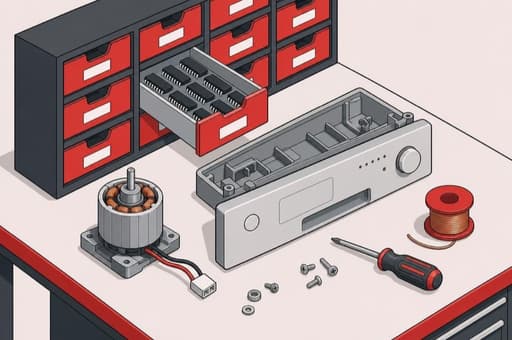
Microcontrollers (PIC, AVR, dsPIC, SAM, PIC32)
The tiny computers sitting inside motors, appliances and car doors — half of all sales, $2.36B in FY2026. Sales jumped about 39% in the June quarter as the slump ended. Watch whether factory and car orders keep catching up.
Competes with STM32 microcontrollers (STMicroelectronics) · S32K automotive microcontrollers (NXP) · RA and RX microcontrollers (Renesas)
In plain English
A microcontroller is a whole little computer squeezed onto a single chip: memory, a processor, and the pins that read a sensor or drive a motor, all for a few dollars.
Microchip keeps thousands of versions on the shelf. An engineer designing a dishwasher or a car door module picks one, writes the software with Microchip's free tools, and that choice is then locked in for the life of the product — five to twenty years of repeat orders. Roughly 101,000 customers buy this way, and that long tail of small, locked-in orders is the real asset.
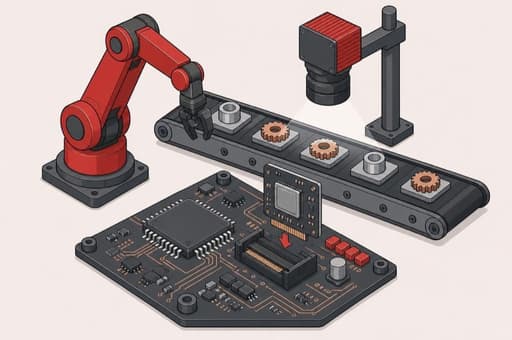
Hailo Edge AI Processors
A deal signed in July 2026 for Hailo, which builds chips that let a camera or robot work out what it is looking at on the spot. Terms undisclosed, its sales small; management says it pulls the roadmap forward about five years.
Competes with Jetson edge modules (NVIDIA) · CVflow vision chips (Ambarella) · Metis accelerators (Axelera AI)
In plain English
Cameras and robots increasingly have to recognise what is in front of them — a person, a pallet, a cracked part — inside the device itself rather than somewhere far away.
Hailo builds the chips that do that job, along with the software to program them. Its own sales are small and it had to restructure after running into money trouble, which is how it came up for sale. Microchip's plan is unfussy: put Hailo's parts in front of its own sales force and its existing customers, so they get bought alongside the control chips those customers already order.
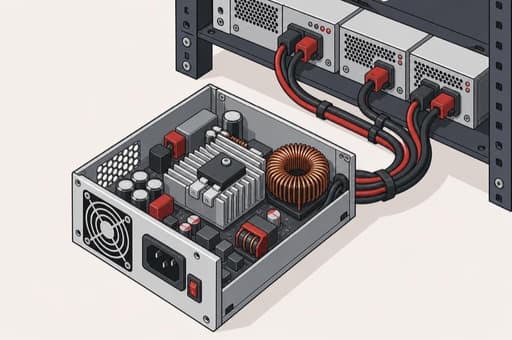
Analog Products
Power, interface and sensing parts that sit beside the microcontroller — $1.33B in FY2026, and the fastest-growing reported line at about 15%. The June quarter was up 30%. Watch how much of it rides on power supplies headed for data centers.
Competes with Power management and interface catalog (Texas Instruments) · Signal-chain and power portfolio (Analog Devices) · Power and discrete lines (Infineon)
In plain English
Not every job on a circuit board is computing. Something has to turn wall power into the exact voltage a chip wants, push data down a long cable, sense heat, or switch a big motor on and off. That is the analog half of electronics.
Microchip sells thousands of those parts, many alongside its own microcontrollers, plenty on their own into power supplies, motor drives and networking gear. Power-supply builders such as LITEON and Delta put them inside units that end up in data centers, which is one place the recent demand has come from.
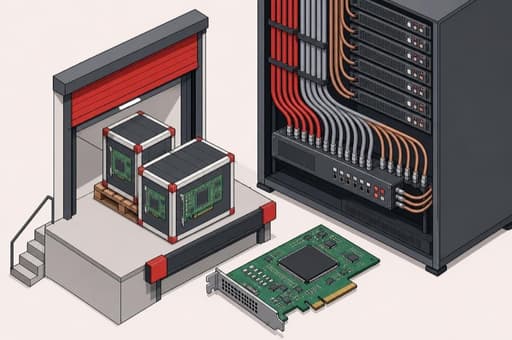
Data Center Solutions
Switches, signal repeaters and drive controllers — the plumbing of a server rack. About $302M in calendar 2025, heading to roughly $500M in 2026. Microchip led earlier generations, lost nearly all of the last one to Broadcom, and has fourteen wins booked on the next.
Competes with PEX and Atlas switches (Broadcom) · Scorpio switches and Aries retimers (Astera Labs) · Bravera storage controllers (Marvell)
In plain English
Inside an AI server, data has to get from the processors to the memory and the drives without jamming up. Microchip sells the traffic parts: switches that fan one fast lane into many, repeaters that keep a signal readable across a long board, and the controllers that run solid-state drives.
Counting catalog chips that also end up in servers, all of Microchip's data-center sales came to roughly $591 million last calendar year and are guided to about $1 billion this one — money already counted inside the other product families, not stacked on top of them. The fourteen newest-generation wins are not shipping in volume yet.
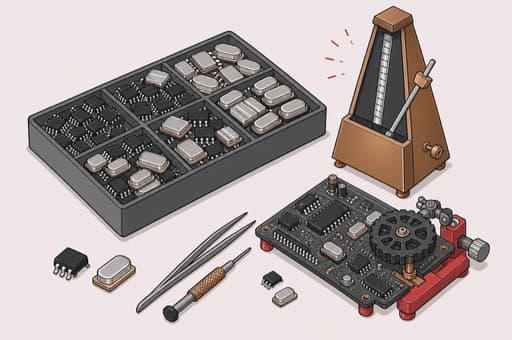
Memory, Timing Systems and Other Products
Memory chips that hold settings through a power cut, clock chips that keep everything in step, and assorted older parts. Close to a tenth of sales, growing slowly — the new pull is servers and storage, where fresh design wins start shipping in 2027.
Competes with Precision timing chips (SiTime) · IDT clock and timing parts (Renesas) · Serial EEPROM memory (STMicroelectronics)
In plain English
A serial number has to survive being unplugged; a fast processor needs something ticking a steady beat so the rest of the board stays in step. Those two humble jobs are what most of these parts do.
They are cheap, sold by the million out of the catalog, and nobody buys a product because of them — but nothing ships without them. Microchip runs many through its own factories, which matters: a factory sitting half-idle burns money, so filling it with steady high-volume parts helps profit margins. The growth here is servers and storage, where newly won designs begin shipping in 2027.
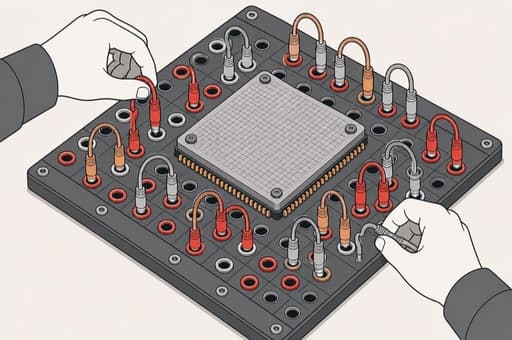
FPGAs and SoC FPGAs (PolarFire)
Chips whose internal wiring the customer sets after manufacture, sold into communications gear, factory cameras, defense and space. Management refuses to publish the revenue, saying it would only help rivals, while claiming very large growth — so this figure is an estimate.
Competes with Certus and Avant FPGAs (Lattice) · Agilex 3 and 5 FPGAs (Altera) · Artix and Spartan FPGAs (AMD)
In plain English
Most chips are fixed at the factory: the wiring inside is decided and that is that. This kind is the opposite — a field of blank logic blocks that the buyer wires up by loading a design file, and can rewire later.
Engineers pay extra for that when volumes are too small to justify a chip made to order, or when the standard they must meet has not settled down. Microchip's versions are built for low power, and some carry a small processor on the same piece of silicon. Once a design is written in Microchip's free tools, moving it elsewhere means starting over.
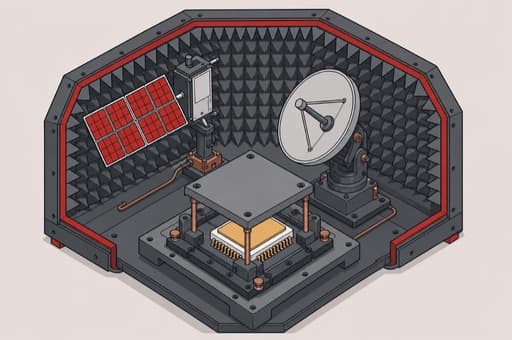
Aerospace & Defense Portfolio
Radiation-tolerant logic chips, a spaceflight processor family, space-grade clocks and rugged analog. It was 16.7% of last quarter's sales, up about 46% from a year earlier; management calls the missile, drone and radar orders a multiyear buildup.
Competes with RAD5545 radiation-hardened processors (BAE Systems) · RT Kintex UltraScale FPGAs (AMD) · NG-ULTRA rad-hard SoC FPGA (NanoXplore)
In plain English
Space is rough on electronics — radiation scrambles ordinary chips, so satellites and interceptors need parts built and screened to survive it.
Microchip sells that hardened version of its catalog: rewirable logic chips, a 64-bit processor family that NASA's Jet Propulsion Laboratory picked to give spacecraft far more computing power, clock chips and tough analog parts. Governments, defense primes and satellite builders buy mostly direct rather than through resellers, on programmes that run for years, so the orders come slowly and then stay. These sales sit inside the product families above rather than on top of them.
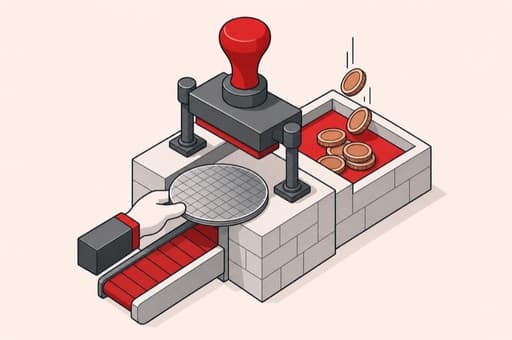
SuperFlash Licensing (Silicon Storage Technology)
Microchip's memory recipe, rented to other chipmakers and foundries for fees and royalties — $163.8M in FY2026 at essentially no cost to produce. It is lumpy: one quarter came in at $58.9M against $32–43M in the ones around it.
Competes with ReRAM memory technology (Weebit Nano) · Foundry's own embedded flash (TSMC) · Embedded memory options (GlobalFoundries)
In plain English
Here is the one line where Microchip ships nothing at all. Its Silicon Storage Technology arm worked out a way to build memory that holds its contents with the power off directly into other companies' chips, and it rents that method out.
Foundries and rival chipmakers pay an upfront fee and then a royalty on what they make with it; by the unit's own count more than 75 billion chips have shipped that way. With no factory cost attached, nearly every dollar lands as profit, so a strong licensing quarter flatters the whole company. The risk is newer memory methods aimed at the smallest chip sizes.


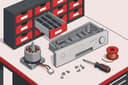 Microcontrollers (PIC, AVR, dsPIC, SAM, PIC32)The tiny computers sitting inside motors, appliances and car doors — half of all sales, $2.36B in FY2026. Sales jumped about 39% in the June quarter as the slump ended. Watch whether factory and car orders keep catching up.
The tiny computers sitting inside motors, appliances and car doors — half of all sales, $2.36B in FY2026. Sales jumped about 39% in the June quarter as the slump ended. Watch whether factory and car orders keep catching up.
In plain English
A microcontroller is a whole little computer squeezed onto a single chip: memory, a processor, and the pins that read a sensor or drive a motor, all for a few dollars.
Microchip keeps thousands of versions on the shelf. An engineer designing a dishwasher or a car door module picks one, writes the software with Microchip's free tools, and that choice is then locked in for the life of the product — five to twenty years of repeat orders. Roughly 101,000 customers buy this way, and that long tail of small, locked-in orders is the real asset.
Competes with STM32 microcontrollers (STMicroelectronics) · S32K automotive microcontrollers (NXP) · RA and RX microcontrollers (Renesas)
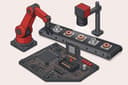 Hailo Edge AI ProcessorsA deal signed in July 2026 for Hailo, which builds chips that let a camera or robot work out what it is looking at on the spot. Terms undisclosed, its sales small; management says it pulls the roadmap forward about five years.
A deal signed in July 2026 for Hailo, which builds chips that let a camera or robot work out what it is looking at on the spot. Terms undisclosed, its sales small; management says it pulls the roadmap forward about five years.
In plain English
Cameras and robots increasingly have to recognise what is in front of them — a person, a pallet, a cracked part — inside the device itself rather than somewhere far away.
Hailo builds the chips that do that job, along with the software to program them. Its own sales are small and it had to restructure after running into money trouble, which is how it came up for sale. Microchip's plan is unfussy: put Hailo's parts in front of its own sales force and its existing customers, so they get bought alongside the control chips those customers already order.
Competes with Jetson edge modules (NVIDIA) · CVflow vision chips (Ambarella) · Metis accelerators (Axelera AI)
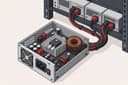 Analog ProductsPower, interface and sensing parts that sit beside the microcontroller — $1.33B in FY2026, and the fastest-growing reported line at about 15%. The June quarter was up 30%. Watch how much of it rides on power supplies headed for data centers.
Power, interface and sensing parts that sit beside the microcontroller — $1.33B in FY2026, and the fastest-growing reported line at about 15%. The June quarter was up 30%. Watch how much of it rides on power supplies headed for data centers.
In plain English
Not every job on a circuit board is computing. Something has to turn wall power into the exact voltage a chip wants, push data down a long cable, sense heat, or switch a big motor on and off. That is the analog half of electronics.
Microchip sells thousands of those parts, many alongside its own microcontrollers, plenty on their own into power supplies, motor drives and networking gear. Power-supply builders such as LITEON and Delta put them inside units that end up in data centers, which is one place the recent demand has come from.
Competes with Power management and interface catalog (Texas Instruments) · Signal-chain and power portfolio (Analog Devices) · Power and discrete lines (Infineon)
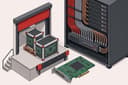 Data Center SolutionsSwitches, signal repeaters and drive controllers — the plumbing of a server rack. About $302M in calendar 2025, heading to roughly $500M in 2026. Microchip led earlier generations, lost nearly all of the last one to Broadcom, and has fourteen wins booked on the next.
Switches, signal repeaters and drive controllers — the plumbing of a server rack. About $302M in calendar 2025, heading to roughly $500M in 2026. Microchip led earlier generations, lost nearly all of the last one to Broadcom, and has fourteen wins booked on the next.
In plain English
Inside an AI server, data has to get from the processors to the memory and the drives without jamming up. Microchip sells the traffic parts: switches that fan one fast lane into many, repeaters that keep a signal readable across a long board, and the controllers that run solid-state drives.
Counting catalog chips that also end up in servers, all of Microchip's data-center sales came to roughly $591 million last calendar year and are guided to about $1 billion this one — money already counted inside the other product families, not stacked on top of them. The fourteen newest-generation wins are not shipping in volume yet.
Competes with PEX and Atlas switches (Broadcom) · Scorpio switches and Aries retimers (Astera Labs) · Bravera storage controllers (Marvell)
 Memory, Timing Systems and Other ProductsMemory chips that hold settings through a power cut, clock chips that keep everything in step, and assorted older parts. Close to a tenth of sales, growing slowly — the new pull is servers and storage, where fresh design wins start shipping in 2027.
Memory chips that hold settings through a power cut, clock chips that keep everything in step, and assorted older parts. Close to a tenth of sales, growing slowly — the new pull is servers and storage, where fresh design wins start shipping in 2027.
In plain English
A serial number has to survive being unplugged; a fast processor needs something ticking a steady beat so the rest of the board stays in step. Those two humble jobs are what most of these parts do.
They are cheap, sold by the million out of the catalog, and nobody buys a product because of them — but nothing ships without them. Microchip runs many through its own factories, which matters: a factory sitting half-idle burns money, so filling it with steady high-volume parts helps profit margins. The growth here is servers and storage, where newly won designs begin shipping in 2027.
Competes with Precision timing chips (SiTime) · IDT clock and timing parts (Renesas) · Serial EEPROM memory (STMicroelectronics)
 FPGAs and SoC FPGAs (PolarFire)Chips whose internal wiring the customer sets after manufacture, sold into communications gear, factory cameras, defense and space. Management refuses to publish the revenue, saying it would only help rivals, while claiming very large growth — so this figure is an estimate.
Chips whose internal wiring the customer sets after manufacture, sold into communications gear, factory cameras, defense and space. Management refuses to publish the revenue, saying it would only help rivals, while claiming very large growth — so this figure is an estimate.
In plain English
Most chips are fixed at the factory: the wiring inside is decided and that is that. This kind is the opposite — a field of blank logic blocks that the buyer wires up by loading a design file, and can rewire later.
Engineers pay extra for that when volumes are too small to justify a chip made to order, or when the standard they must meet has not settled down. Microchip's versions are built for low power, and some carry a small processor on the same piece of silicon. Once a design is written in Microchip's free tools, moving it elsewhere means starting over.
Competes with Certus and Avant FPGAs (Lattice) · Agilex 3 and 5 FPGAs (Altera) · Artix and Spartan FPGAs (AMD)
 Aerospace & Defense PortfolioRadiation-tolerant logic chips, a spaceflight processor family, space-grade clocks and rugged analog. It was 16.7% of last quarter's sales, up about 46% from a year earlier; management calls the missile, drone and radar orders a multiyear buildup.
Radiation-tolerant logic chips, a spaceflight processor family, space-grade clocks and rugged analog. It was 16.7% of last quarter's sales, up about 46% from a year earlier; management calls the missile, drone and radar orders a multiyear buildup.
In plain English
Space is rough on electronics — radiation scrambles ordinary chips, so satellites and interceptors need parts built and screened to survive it.
Microchip sells that hardened version of its catalog: rewirable logic chips, a 64-bit processor family that NASA's Jet Propulsion Laboratory picked to give spacecraft far more computing power, clock chips and tough analog parts. Governments, defense primes and satellite builders buy mostly direct rather than through resellers, on programmes that run for years, so the orders come slowly and then stay. These sales sit inside the product families above rather than on top of them.
Competes with RAD5545 radiation-hardened processors (BAE Systems) · RT Kintex UltraScale FPGAs (AMD) · NG-ULTRA rad-hard SoC FPGA (NanoXplore)
 SuperFlash Licensing (Silicon Storage Technology)Microchip's memory recipe, rented to other chipmakers and foundries for fees and royalties — $163.8M in FY2026 at essentially no cost to produce. It is lumpy: one quarter came in at $58.9M against $32–43M in the ones around it.
Microchip's memory recipe, rented to other chipmakers and foundries for fees and royalties — $163.8M in FY2026 at essentially no cost to produce. It is lumpy: one quarter came in at $58.9M against $32–43M in the ones around it.
In plain English
Here is the one line where Microchip ships nothing at all. Its Silicon Storage Technology arm worked out a way to build memory that holds its contents with the power off directly into other companies' chips, and it rents that method out.
Foundries and rival chipmakers pay an upfront fee and then a royalty on what they make with it; by the unit's own count more than 75 billion chips have shipped that way. With no factory cost attached, nearly every dollar lands as profit, so a strong licensing quarter flatters the whole company. The risk is newer memory methods aimed at the smallest chip sizes.
Competes with ReRAM memory technology (Weebit Nano) · Foundry's own embedded flash (TSMC) · Embedded memory options (GlobalFoundries)
Named in filings, launches and programs
- Arrow ElectronicsCustomer programParts reseller that accounted for 12% of FY2026 sales — the only counterparty above a tenth, in a year when 47% of sales went through resellers.
- PCIe Gen 6 anchor design winCustomer program · RampingOne undisclosed buyer expected to bring more than $100 million of revenue in calendar 2027, with production starting early that year.
- PIC64-HPSC spaceflight processorProduct · RampingRadiation-hardened 64-bit processor family for spacecraft, stemming from a 2022 NASA Jet Propulsion Laboratory selection.
- Space-grade timing chipsProductRadiation-tolerant clock parts such as the DSA504RT that keep spacecraft electronics ticking in step.
- MPLAB development toolsEcosystemThe software engineers use to program Microchip chips; compilers and machine-learning tools went free in July 2026, and habit keeps designers here.
- VectorBlox 3.0 SDKPlatformToolkit released July 2026 for running neural networks on PolarFire chips, trimming the network so the chip skips empty work.
- memBrain SAGEProductLicensed design that lets memory cells do AI arithmetic themselves; AnalogAI signed on in September 2026 for its first edge processors.
- ASA Motion Link display connectivityProductOpen-standard display link for software-defined cars, shown with parts maker Marelli in September 2026; no production timing given.
- Ethernet T1S connectivityEcosystem · RampingConnection chips for a newer Ethernet wiring standard, put front and centre by the networking unit in February 2026; still early.
Arrow ElectronicsCustomer program
Parts reseller that accounted for 12% of FY2026 sales — the only counterparty above a tenth, in a year when 47% of sales went through resellers.
PCIe Gen 6 anchor design winCustomer program · Ramping
One undisclosed buyer expected to bring more than $100 million of revenue in calendar 2027, with production starting early that year.
PIC64-HPSC spaceflight processorProduct · Ramping
Radiation-hardened 64-bit processor family for spacecraft, stemming from a 2022 NASA Jet Propulsion Laboratory selection.
Space-grade timing chipsProduct
Radiation-tolerant clock parts such as the DSA504RT that keep spacecraft electronics ticking in step.
MPLAB development toolsEcosystem
The software engineers use to program Microchip chips; compilers and machine-learning tools went free in July 2026, and habit keeps designers here.
VectorBlox 3.0 SDKPlatform
Toolkit released July 2026 for running neural networks on PolarFire chips, trimming the network so the chip skips empty work.
memBrain SAGEProduct
Licensed design that lets memory cells do AI arithmetic themselves; AnalogAI signed on in September 2026 for its first edge processors.
ASA Motion Link display connectivityProduct
Open-standard display link for software-defined cars, shown with parts maker Marelli in September 2026; no production timing given.
Ethernet T1S connectivityEcosystem · Ramping
Connection chips for a newer Ethernet wiring standard, put front and centre by the networking unit in February 2026; still early.