
News Corp Class A (NWSA)
Combines Dow Jones, property marketplaces, HarperCollins and English-language news publishing.
Something off on this page? Send us feedback.
News Corp is a holding company for a spread of news and information businesses: newspapers in America, Britain and Australia, the Wall Street Journal, one of the world's big book publishers, and property listing websites. Revenue is split fairly evenly between them; profit is not — the property sites earn the biggest share. With pay television sold, the weight is shifting toward data sold to companies and toward renting its journalism to artificial-intelligence firms.
Item facts: FY2026 · year ended June 30, 2026, from filings, earnings calls and company pages.
Judgment weights, not filed revenue
The band summarizes business focus and direction. ~ marks estimates.
8 in detail · 14 more below

Dow Jones Professional Information
The stated growth engine: tools that check names against sanctions lists, daily price assessments for fuel and chemicals, and a searchable news archive. Management's goal is $1 billion of annual Dow Jones operating earnings by fiscal 2030, against $588 million in fiscal 2025.
Competes with World-Check screening (LSEG) · KYC and Orbis entity data (Moody's) · Platts price assessments (S&P Global)
In plain English
Banks are not allowed to do business with sanctioned people, and a fuel trader needs to know what cargoes changed hands for this morning. Dow Jones sells both answers — name-screening lists, price assessments for fuel and chemicals, and a searchable store of past news stories.
Companies buy seats for their staff and renew year after year; about nine in ten renew in the screening and energy lines. That makes it the steadiest money in the group. The screening business has grown close to a fifth a year since 2018, while the energy side cooled to 4% growth by the last quarter of the year.
The Wall Street Journal & Barron's
The consumer half of Dow Jones — the Journal, Barron's and MarketWatch, sold by subscription with advertising on top. Digital-only subscriptions across Dow Jones reached nearly 6.3 million, up 9%, with growth leaning on price and employer deals rather than crowds of new readers.
Competes with Digital news bundle (The New York Times) · Bloomberg.com and Bloomberg Professional (Bloomberg) · FT subscription (Nikkei)
In plain English
Start with a daily business newspaper and its weekend markets sibling, now read mostly on a phone rather than folded on a train. Readers pay a monthly fee to get in; advertisers pay to sit beside them.
The listed monthly price for the Journal is about 15% higher than it was two years ago, though employers who buy blocks of seats for their staff pay less per head, so the average subscriber pays well under the sticker price. That is the shape of the business: reader numbers creep up, so the money has to come from price, bulk deals, and new places the journalism turns up.
AI and enterprise content licensing
Contracts letting AI developers use News Corp journalism. OpenAI and Meta are the biggest named buyers, together reported at roughly $100 million a year — small revenue, high margin. What to watch: whether the pipeline of further deals turns into signatures.
Competes with Archive and feed licensing (Associated Press) · News archives for AI buyers (Reuters) · News licensing stance (The New York Times)
In plain English
The other way to sell journalism: not to readers, but to the machines that answer questions. Chatbots need current, checked writing, and this company has a lot of it — the Journal, the New York Post, the Australian and British papers.
OpenAI signed for five years at a reported $250 million; Meta signed for three years at a reported $50 million a year; Bloomberg and the market-data firm LSEG bought narrower rights. Neither headline amount is confirmed by the company. Management describes the policy as woo or sue, and it is suing Perplexity and Brave over the use of its articles.
realestate.com.au
Australia's largest home-listing site, held through a majority stake in separately listed REA Group. Agents pay per listing and pay more each year for prominence, so revenue climbs on price rather than on more homes for sale. CoStar now owns the number two site.
Competes with Domain portal (CoStar Group) · Rightmove portal (Rightmove)
In plain English
The place Australians look when they want to buy a house — the country's biggest listing site for homes. Estate agents pay to put each property on it, and pay more for a bigger, higher-placed listing, with prices stepping up every year. A market square where one stall has most of the shoppers, so the rent keeps rising.
Two catches. News Corp owns about 62% of the separately listed company that runs it, so roughly $170 million of last year's group profit belonged to outside shareholders, chiefly theirs. And in 2025 CoStar — which also runs the US portal Homes.com — bought the number two Australian site and says it is closing the audience gap.

Realtor.com
The US home-search site, run by Move, Inc. Agents buy leads and prominent placement. Seven straight quarters of growth and visit share up from under 30% to roughly a third — but Zillow is still the bigger draw and home sales stay slow.
Competes with Premier Agent leads (Zillow Group) · Homes.com portal (CoStar Group) · Redfin portal and brokerage (Rocket Companies)
In plain English
When Americans go house-hunting they browse listings online. Realtor.com sells the introduction that follows: agents and rental operators pay for leads — the details of an interested buyer — and for showing up first, plus newer lines like new-build homes and rentals, about a fifth of sales.
American home sales stay depressed, which caps how many buyers there are to pass along. So the business earns over 20% more per home sold than it did four years ago and keeps grinding at Zillow's lead, including by putting its listings inside ChatGPT. Management's own guidance amounts to this: it gets easier when mortgage rates ease.
HarperCollins Publishers
The book publisher, 120-plus imprints from Harlequin to Zondervan. Biggest revenue line in the company at $2,288 million, and the least profitable: $287 million of operating earnings. Older titles still in print carried 64% of consumer sales.
Competes with Penguin Random House trade list (Bertelsmann) · Hachette trade list (Hachette) · Audible originals (Amazon)
In plain English
Books, the old-fashioned way. HarperCollins pays authors advances, prints their books and ships them to Amazon and the big chains, which can send back whatever does not sell. Every copy carries its own cost, which is why the largest revenue line in the company throws off only about twelve and a half cents of operating earnings per dollar of sales.
The quiet strength is the backlist — books published years ago that keep selling, roughly two-thirds of consumer sales. Audiobook sales rose 16% in the final quarter of the year, and a screen adaptation can wake a series up: one lifted the Game Changer books last year.
News Corp Australia
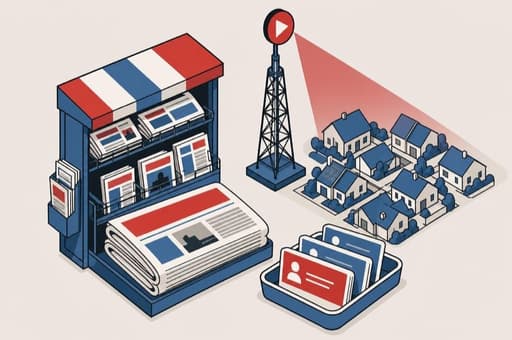
The Australian newspapers — The Australian, Daily Telegraph, Herald Sun, Courier Mail — plus the Sky News Australia channel. More than a million digital subscribers at the last count sit against print advertising that shrinks a little every year.
Competes with SMH, The Age and AFR newspapers (Nine Entertainment) · ABC News (Australian Broadcasting Corporation) · Seven News broadcasts (Seven West Media)
In plain English
Australia is where News Corp owns a row of big-city newspapers: The Australian, the Daily Telegraph in Sydney, the Herald Sun in Melbourne, the Courier Mail in Brisbane. Since the pay-television sale, the Sky News Australia channel is counted here too, and it reaches most of its audience on YouTube.
The money arrives in two pockets moving in opposite directions. Readers increasingly pay for digital subscriptions — over a million of them at the last count. Advertisers spend less on newsprint each year: across all of the company's newspapers and news channels, advertising brought in $776 million last year, down 2%, and down 5% once currency swings are stripped out.
News UK
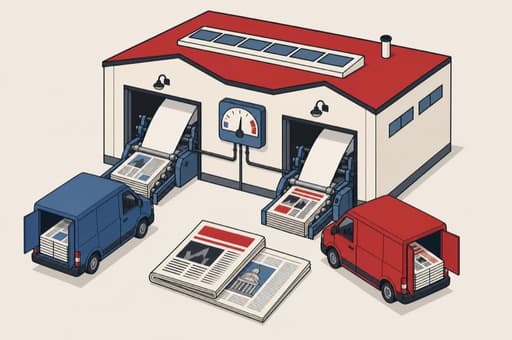
The Sun, The Times and the Sunday Times, plus the talkSPORT and Virgin Radio stations. The weak spot of the newspaper business: quarterly earnings across the papers fell, blamed partly on News UK, so the answer has been sharing presses with a rival.
Competes with Daily Mail and Mail Online (DMG Media) · Mirror and Express titles (Reach) · Telegraph digital subscriptions (The Telegraph)
In plain English
The British arm: The Sun, a mass-market tabloid; The Times and Sunday Times, its serious-newspaper sibling; and two radio stations, talkSPORT and Virgin Radio. Readers buy copies and subscriptions, advertisers buy space and airtime.
British print keeps shrinking, and the interesting response is a deal with the enemy. News UK combined its printing plants with those of the Daily Mail's owner, cleared by the competition regulator in 2024, so both carry the cost of the same presses — and Reach, publisher of the Mirror, now prints there too. Rather than chase growth here, the plan is to make the decline cheaper.


 Dow Jones Professional InformationThe stated growth engine: tools that check names against sanctions lists, daily price assessments for fuel and chemicals, and a searchable news archive. Management's goal is $1 billion of annual Dow Jones operating earnings by fiscal 2030, against $588 million in fiscal 2025.
The stated growth engine: tools that check names against sanctions lists, daily price assessments for fuel and chemicals, and a searchable news archive. Management's goal is $1 billion of annual Dow Jones operating earnings by fiscal 2030, against $588 million in fiscal 2025.
In plain English
Banks are not allowed to do business with sanctioned people, and a fuel trader needs to know what cargoes changed hands for this morning. Dow Jones sells both answers — name-screening lists, price assessments for fuel and chemicals, and a searchable store of past news stories.
Companies buy seats for their staff and renew year after year; about nine in ten renew in the screening and energy lines. That makes it the steadiest money in the group. The screening business has grown close to a fifth a year since 2018, while the energy side cooled to 4% growth by the last quarter of the year.
Competes with World-Check screening (LSEG) · KYC and Orbis entity data (Moody's) · Platts price assessments (S&P Global)
 The Wall Street Journal & Barron'sThe consumer half of Dow Jones — the Journal, Barron's and MarketWatch, sold by subscription with advertising on top. Digital-only subscriptions across Dow Jones reached nearly 6.3 million, up 9%, with growth leaning on price and employer deals rather than crowds of new readers.
The consumer half of Dow Jones — the Journal, Barron's and MarketWatch, sold by subscription with advertising on top. Digital-only subscriptions across Dow Jones reached nearly 6.3 million, up 9%, with growth leaning on price and employer deals rather than crowds of new readers.
In plain English
Start with a daily business newspaper and its weekend markets sibling, now read mostly on a phone rather than folded on a train. Readers pay a monthly fee to get in; advertisers pay to sit beside them.
The listed monthly price for the Journal is about 15% higher than it was two years ago, though employers who buy blocks of seats for their staff pay less per head, so the average subscriber pays well under the sticker price. That is the shape of the business: reader numbers creep up, so the money has to come from price, bulk deals, and new places the journalism turns up.
Competes with Digital news bundle (The New York Times) · Bloomberg.com and Bloomberg Professional (Bloomberg) · FT subscription (Nikkei)
 AI and enterprise content licensingContracts letting AI developers use News Corp journalism. OpenAI and Meta are the biggest named buyers, together reported at roughly $100 million a year — small revenue, high margin. What to watch: whether the pipeline of further deals turns into signatures.
Contracts letting AI developers use News Corp journalism. OpenAI and Meta are the biggest named buyers, together reported at roughly $100 million a year — small revenue, high margin. What to watch: whether the pipeline of further deals turns into signatures.
In plain English
The other way to sell journalism: not to readers, but to the machines that answer questions. Chatbots need current, checked writing, and this company has a lot of it — the Journal, the New York Post, the Australian and British papers.
OpenAI signed for five years at a reported $250 million; Meta signed for three years at a reported $50 million a year; Bloomberg and the market-data firm LSEG bought narrower rights. Neither headline amount is confirmed by the company. Management describes the policy as woo or sue, and it is suing Perplexity and Brave over the use of its articles.
Competes with Archive and feed licensing (Associated Press) · News archives for AI buyers (Reuters) · News licensing stance (The New York Times)
 realestate.com.auAustralia's largest home-listing site, held through a majority stake in separately listed REA Group. Agents pay per listing and pay more each year for prominence, so revenue climbs on price rather than on more homes for sale. CoStar now owns the number two site.
Australia's largest home-listing site, held through a majority stake in separately listed REA Group. Agents pay per listing and pay more each year for prominence, so revenue climbs on price rather than on more homes for sale. CoStar now owns the number two site.
In plain English
The place Australians look when they want to buy a house — the country's biggest listing site for homes. Estate agents pay to put each property on it, and pay more for a bigger, higher-placed listing, with prices stepping up every year. A market square where one stall has most of the shoppers, so the rent keeps rising.
Two catches. News Corp owns about 62% of the separately listed company that runs it, so roughly $170 million of last year's group profit belonged to outside shareholders, chiefly theirs. And in 2025 CoStar — which also runs the US portal Homes.com — bought the number two Australian site and says it is closing the audience gap.
Competes with Domain portal (CoStar Group) · Rightmove portal (Rightmove)
 Realtor.comThe US home-search site, run by Move, Inc. Agents buy leads and prominent placement. Seven straight quarters of growth and visit share up from under 30% to roughly a third — but Zillow is still the bigger draw and home sales stay slow.
The US home-search site, run by Move, Inc. Agents buy leads and prominent placement. Seven straight quarters of growth and visit share up from under 30% to roughly a third — but Zillow is still the bigger draw and home sales stay slow.
In plain English
When Americans go house-hunting they browse listings online. Realtor.com sells the introduction that follows: agents and rental operators pay for leads — the details of an interested buyer — and for showing up first, plus newer lines like new-build homes and rentals, about a fifth of sales.
American home sales stay depressed, which caps how many buyers there are to pass along. So the business earns over 20% more per home sold than it did four years ago and keeps grinding at Zillow's lead, including by putting its listings inside ChatGPT. Management's own guidance amounts to this: it gets easier when mortgage rates ease.
Competes with Premier Agent leads (Zillow Group) · Homes.com portal (CoStar Group) · Redfin portal and brokerage (Rocket Companies)
 HarperCollins PublishersThe book publisher, 120-plus imprints from Harlequin to Zondervan. Biggest revenue line in the company at $2,288 million, and the least profitable: $287 million of operating earnings. Older titles still in print carried 64% of consumer sales.
The book publisher, 120-plus imprints from Harlequin to Zondervan. Biggest revenue line in the company at $2,288 million, and the least profitable: $287 million of operating earnings. Older titles still in print carried 64% of consumer sales.
In plain English
Books, the old-fashioned way. HarperCollins pays authors advances, prints their books and ships them to Amazon and the big chains, which can send back whatever does not sell. Every copy carries its own cost, which is why the largest revenue line in the company throws off only about twelve and a half cents of operating earnings per dollar of sales.
The quiet strength is the backlist — books published years ago that keep selling, roughly two-thirds of consumer sales. Audiobook sales rose 16% in the final quarter of the year, and a screen adaptation can wake a series up: one lifted the Game Changer books last year.
Competes with Penguin Random House trade list (Bertelsmann) · Hachette trade list (Hachette) · Audible originals (Amazon)
 News Corp AustraliaThe Australian newspapers — The Australian, Daily Telegraph, Herald Sun, Courier Mail — plus the Sky News Australia channel. More than a million digital subscribers at the last count sit against print advertising that shrinks a little every year.
The Australian newspapers — The Australian, Daily Telegraph, Herald Sun, Courier Mail — plus the Sky News Australia channel. More than a million digital subscribers at the last count sit against print advertising that shrinks a little every year.
In plain English
Australia is where News Corp owns a row of big-city newspapers: The Australian, the Daily Telegraph in Sydney, the Herald Sun in Melbourne, the Courier Mail in Brisbane. Since the pay-television sale, the Sky News Australia channel is counted here too, and it reaches most of its audience on YouTube.
The money arrives in two pockets moving in opposite directions. Readers increasingly pay for digital subscriptions — over a million of them at the last count. Advertisers spend less on newsprint each year: across all of the company's newspapers and news channels, advertising brought in $776 million last year, down 2%, and down 5% once currency swings are stripped out.
Competes with SMH, The Age and AFR newspapers (Nine Entertainment) · ABC News (Australian Broadcasting Corporation) · Seven News broadcasts (Seven West Media)
 News UKThe Sun, The Times and the Sunday Times, plus the talkSPORT and Virgin Radio stations. The weak spot of the newspaper business: quarterly earnings across the papers fell, blamed partly on News UK, so the answer has been sharing presses with a rival.
The Sun, The Times and the Sunday Times, plus the talkSPORT and Virgin Radio stations. The weak spot of the newspaper business: quarterly earnings across the papers fell, blamed partly on News UK, so the answer has been sharing presses with a rival.
In plain English
The British arm: The Sun, a mass-market tabloid; The Times and Sunday Times, its serious-newspaper sibling; and two radio stations, talkSPORT and Virgin Radio. Readers buy copies and subscriptions, advertisers buy space and airtime.
British print keeps shrinking, and the interesting response is a deal with the enemy. News UK combined its printing plants with those of the Daily Mail's owner, cleared by the competition regulator in 2024, so both carry the cost of the same presses — and Reach, publisher of the Mirror, now prints there too. Rather than chase growth here, the plan is to make the decline cheaper.
Competes with Daily Mail and Mail Online (DMG Media) · Mirror and Express titles (Reach) · Telegraph digital subscriptions (The Telegraph)
Named in filings, launches and programs
- New York Post Media GroupBrandThe Post, Page Six, Decider and Alexa — a tabloid and entertainment stable reporting roughly 100 million monthly visitors.
- California PostProduct · RampingA West Coast edition of the New York Post launched in January 2026, and named as a drag on newspaper earnings.
- HamiltonPlatformThe New York Post's suite of AI tools, launched in August 2026 and built on Google Cloud's Gemini technology.
- Sky News AustraliaBrandThe news channel folded into the newspaper business after the pay-TV sale; about $17 million of revenue a quarter, most of its audience on YouTube.
- talkSPORT and Virgin RadioBrandBritish radio inside News UK; listening rises and falls with big events, and the coming World Cup is flagged as a lift for fiscal 2027.
- Investor's Business Daily and MarketSurgeProductStock-research tools for individual investors inside Dow Jones; subscribers paid $1,411 each on average in the year to June 2025.
- MarketWatchProductA free-to-read markets and business news site, part of the Dow Jones consumer stable alongside the Journal and Barron's.
- Factiva and NewswiresProductThe searchable store of published articles plus the wire feeds sold to companies — $352 million in fiscal 2025, growing modestly.
- realcommercial.com.auPlatformREA's listing site for commercial property — the business-premises counterpart to its home portal.
- Flatmates.com.auPlatformThe flatmate-listing site in REA's Australian stable, alongside its property data and mortgage broking lines.
- REA financial servicesServiceMortgage broking sold alongside the listings; double-digit growth on 21% more loan settlements in the third quarter of fiscal 2026.
- Realtor.com Plus and RealPRO SelectPlatform · RampingTools sold to US agents for working leads and premium placement, built on ties to the national realtor association and its listing databases.
- NewsprintersServiceThe UK printing operation shared with the Daily Mail's owner, cleared by the competition regulator in 2024; it now prints for rival publisher Reach.
- DAZN stakeBrandA roughly 6% holding in DAZN, the buyer of the Foxtel pay-TV business, kept back from that sale along with a seat on its board.
New York Post Media GroupBrand
The Post, Page Six, Decider and Alexa — a tabloid and entertainment stable reporting roughly 100 million monthly visitors.
California PostProduct · Ramping
A West Coast edition of the New York Post launched in January 2026, and named as a drag on newspaper earnings.
HamiltonPlatform
The New York Post's suite of AI tools, launched in August 2026 and built on Google Cloud's Gemini technology.
Sky News AustraliaBrand
The news channel folded into the newspaper business after the pay-TV sale; about $17 million of revenue a quarter, most of its audience on YouTube.
talkSPORT and Virgin RadioBrand
British radio inside News UK; listening rises and falls with big events, and the coming World Cup is flagged as a lift for fiscal 2027.
Investor's Business Daily and MarketSurgeProduct
Stock-research tools for individual investors inside Dow Jones; subscribers paid $1,411 each on average in the year to June 2025.
MarketWatchProduct
A free-to-read markets and business news site, part of the Dow Jones consumer stable alongside the Journal and Barron's.
Factiva and NewswiresProduct
The searchable store of published articles plus the wire feeds sold to companies — $352 million in fiscal 2025, growing modestly.
realcommercial.com.auPlatform
REA's listing site for commercial property — the business-premises counterpart to its home portal.
Flatmates.com.auPlatform
The flatmate-listing site in REA's Australian stable, alongside its property data and mortgage broking lines.
REA financial servicesService
Mortgage broking sold alongside the listings; double-digit growth on 21% more loan settlements in the third quarter of fiscal 2026.
Realtor.com Plus and RealPRO SelectPlatform · Ramping
Tools sold to US agents for working leads and premium placement, built on ties to the national realtor association and its listing databases.
NewsprintersService
The UK printing operation shared with the Daily Mail's owner, cleared by the competition regulator in 2024; it now prints for rival publisher Reach.
DAZN stakeBrand
A roughly 6% holding in DAZN, the buyer of the Foxtel pay-TV business, kept back from that sale along with a seat on its board.