
Vulcan Materials (VMC)
Produces construction aggregates, asphalt mix, and ready-mixed concrete across U.S. growth markets.
Something off on this page? Send us feedback.
Vulcan digs and crushes rock, then sells it by the ton for roads, water lines, foundations and data centers; near its quarries it also mixes that rock into road asphalt and wet concrete. Because rock is too heavy to ship far, each quarry serves the towns around it. The company is now buying more quarries, shrinking the concrete side, and chasing more profit on every ton — with public road budgets setting the pace.
Item facts: FY2025 · year ended Dec 31, 2025, from filings, earnings calls and company pages.
Judgment weights, not filed revenue
The band summarizes business focus and direction. ~ marks estimates.
6 in detail · 10 more below
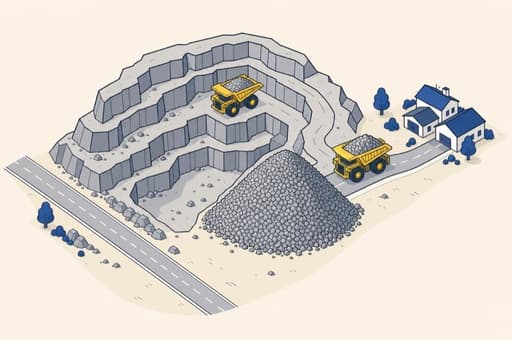
Aggregates
Crushed stone, sand and gravel from 425 quarries and yards, sold by the ton — 226.8 million tons of it in 2025. It earns roughly nine of every ten dollars of Vulcan's profit; the scarce thing is not rock but permission to dig it near growing cities.
Competes with Aggregates product line (Martin Marietta) · Aggregates (CRH Americas Materials) · Aggregates (Heidelberg Materials North America)
In plain English
Rock is heavy and cheap, so nobody ships it far — hauling a load an hour down the road can cost more than digging it up did. That single fact is the whole business: whoever owns the permitted quarry nearest a growing city is, for practical purposes, the only convenient seller.
Vulcan owns 425 of those pits and yards across 23 states, with about 16.6 billion tons of stone counted under them. Highway crews, water-and-sewer contractors, data-center builders and homebuilders buy it load by load, at prices reset every January and negotiated again in the middle of the year. No single customer is even 2% of sales.
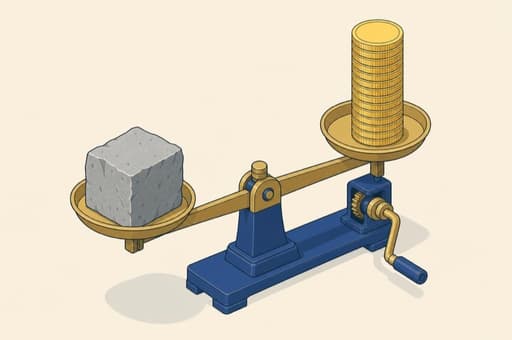
Vulcan Way of Selling & Vulcan Way of Operating
Two in-house rulebooks, one for pricing and one for plant costs, that widened the cash left on a ton of rock to $11.33 in 2025, up 7%. The new chief executive has named $20 a ton as the next target.
Competes with Aggregates unit-margin program (Martin Marietta) · Vertical integration of rock, asphalt and cement (CRH Americas Materials)
In plain English
Selling gravel sounds like it leaves no room for cleverness. Vulcan's answer is two rulebooks: one for the sales side — a price increase every January, then a negotiated one mid-year — and one for the plants, about keeping the cost of producing a ton from creeping up. Unit costs rose under 2% in 2025.
The scoreboard is a single number: the cash left on each ton after making and selling it. It was $7.33 not long ago and $11.33 last year, and Ronnie Pruitt, chief executive since January, has put $20 on the wall. Across roughly 227 million tons, one dollar of that gap is about $227 million. Diesel runs the other way — it took $26 million out of a single quarter this year.
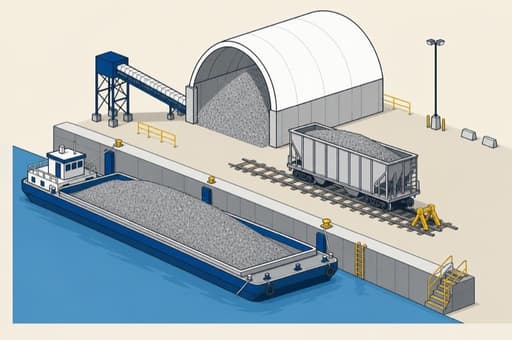
Gulf Coast waterborne and rail distribution network
Ports, barge terminals and rail yards that carry rock into coastal Texas and the Gulf, where there is little stone to quarry locally. The Gulf Coast is roughly two-fifths of sales; what can go wrong is a dock or a permit, not demand.
Competes with Rail and river distribution network (Martin Marietta) · Yucatán aggregates supply (CEMEX)
In plain English
Some places sit on rock. Coastal Texas and the Gulf mostly do not, so the stone has to arrive from somewhere else. Vulcan barges and rails it in, stockpiles it at terminals along the coast and sells it out of the yard — closer to a grocery distributor supplying a town with no farms than to a quarry.
Getting there is the moat and the risk at once: the freight keeps casual sellers away, and one lost port or rail connection can strand a whole market. This network is what kept the coast supplied after Vulcan's Mexican quarry stopped producing in 2022. Chief executive Ronnie Pruitt calls it the best distribution network on the Gulf.
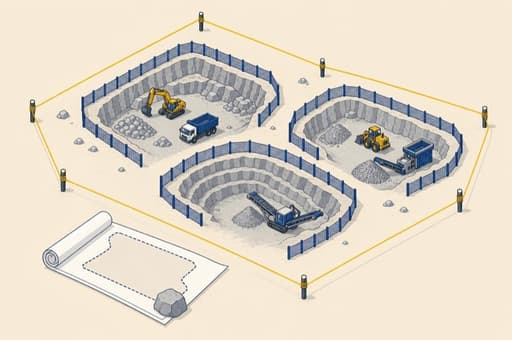
Acquisitions and greenfield quarries
Buying family-owned quarries and opening new ones: six deals in 2024 for about $2.3 billion, and lately near a third of spending going to new sites. Bought tonnage, not existing customers, carried 2025's volume growth.
Competes with Aggregates portfolio deals (BWI Southeast) (Martin Marietta) · Cement and concrete asset swaps (Quikrete) · Bundled materials roll-ups (CRH Americas Materials)
In plain English
Around 1,400 companies dig stone in America, most of them a family and a few pits. Vulcan grows mainly by buying them — Wake Stone in the Carolinas, Brannan in Colorado — and by opening new quarries where it can get a permit, which together take roughly a third of what it spends.
Why bother: a quarry only serves what is within trucking distance, so growth in a new city has to be bought or dug there. In 2025 the purchased pits did the work — shipments rose 3% while the quarries Vulcan already owned sold slightly less. At mid-year borrowings sat at 1.7 times yearly cash earnings against a 2.0–2.5 target, which is the room left for the next deal.
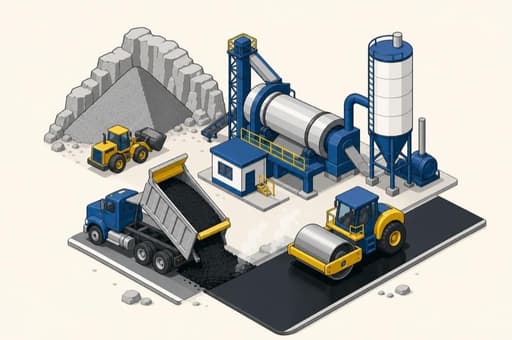
Asphalt
Hot paving mix from 71 plants next to the quarries: $1,294.4M of sales in 2025 on 13.4 million tons. Tons keep slipping while the price per ton rises, and it is the earning half of Vulcan's two mixing businesses.
Competes with Asphalt (CRH Americas Materials) · Asphalt and paving services (Martin Marietta)
In plain English
The black top layer of a road is mostly stone. Vulcan's plants heat its own crushed rock and stir in the sticky tar left at the bottom of an oil refinery, then send it out hot — the crew has to spread it before it cools, which is why the plants sit near both the quarry and the job.
State road agencies and their paving contractors buy it by the ton, and Vulcan's crews also lay some of it. So the stone earns twice: once going into the mixer, once inside the finished pavement. Management expects about 85% of this year's roughly $290 million of mixing cash profit to come from asphalt rather than concrete.
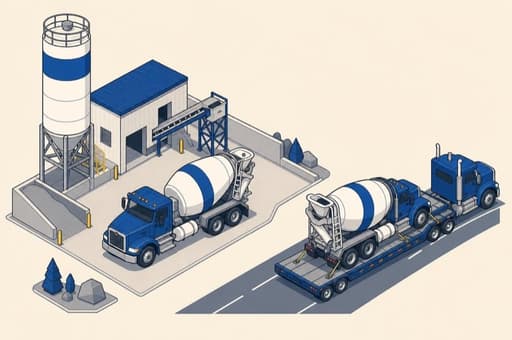
Ready-Mixed Concrete
Wet concrete delivered from 76 plants: $846.6M of sales in 2025 but only $35.9M of profit. Vulcan is shrinking it on purpose — after the California sale closed in June 2026 the line runs nearer 9% of revenue.
Competes with Ready-mixed concrete (CalPortland) · Ready mixed concrete (Martin Marietta)
In plain English
Concrete is rock, sand, cement powder and water, mixed wet and driven to a site in one of those trucks with the slowly turning drum. The clock starts when the water goes in, so a plant can only serve what is about half an hour away.
It is a thin living. Vulcan has to buy the cement — the one ingredient it does not make — from someone else, and every rival inside that half hour sells the same grey slurry. So it sold the California plants to CalPortland, owned by Taiheiyo Cement, for about $712 million in June 2026 and kept the quarries that had been feeding them. The logic: keep the rock, sell the mixer.


 AggregatesCrushed stone, sand and gravel from 425 quarries and yards, sold by the ton — 226.8 million tons of it in 2025. It earns roughly nine of every ten dollars of Vulcan's profit; the scarce thing is not rock but permission to dig it near growing cities.
Crushed stone, sand and gravel from 425 quarries and yards, sold by the ton — 226.8 million tons of it in 2025. It earns roughly nine of every ten dollars of Vulcan's profit; the scarce thing is not rock but permission to dig it near growing cities.
In plain English
Rock is heavy and cheap, so nobody ships it far — hauling a load an hour down the road can cost more than digging it up did. That single fact is the whole business: whoever owns the permitted quarry nearest a growing city is, for practical purposes, the only convenient seller.
Vulcan owns 425 of those pits and yards across 23 states, with about 16.6 billion tons of stone counted under them. Highway crews, water-and-sewer contractors, data-center builders and homebuilders buy it load by load, at prices reset every January and negotiated again in the middle of the year. No single customer is even 2% of sales.
Competes with Aggregates product line (Martin Marietta) · Aggregates (CRH Americas Materials) · Aggregates (Heidelberg Materials North America)
 Vulcan Way of Selling & Vulcan Way of OperatingTwo in-house rulebooks, one for pricing and one for plant costs, that widened the cash left on a ton of rock to $11.33 in 2025, up 7%. The new chief executive has named $20 a ton as the next target.
Two in-house rulebooks, one for pricing and one for plant costs, that widened the cash left on a ton of rock to $11.33 in 2025, up 7%. The new chief executive has named $20 a ton as the next target.
In plain English
Selling gravel sounds like it leaves no room for cleverness. Vulcan's answer is two rulebooks: one for the sales side — a price increase every January, then a negotiated one mid-year — and one for the plants, about keeping the cost of producing a ton from creeping up. Unit costs rose under 2% in 2025.
The scoreboard is a single number: the cash left on each ton after making and selling it. It was $7.33 not long ago and $11.33 last year, and Ronnie Pruitt, chief executive since January, has put $20 on the wall. Across roughly 227 million tons, one dollar of that gap is about $227 million. Diesel runs the other way — it took $26 million out of a single quarter this year.
Competes with Aggregates unit-margin program (Martin Marietta) · Vertical integration of rock, asphalt and cement (CRH Americas Materials)
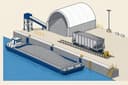 Gulf Coast waterborne and rail distribution networkPorts, barge terminals and rail yards that carry rock into coastal Texas and the Gulf, where there is little stone to quarry locally. The Gulf Coast is roughly two-fifths of sales; what can go wrong is a dock or a permit, not demand.
Ports, barge terminals and rail yards that carry rock into coastal Texas and the Gulf, where there is little stone to quarry locally. The Gulf Coast is roughly two-fifths of sales; what can go wrong is a dock or a permit, not demand.
In plain English
Some places sit on rock. Coastal Texas and the Gulf mostly do not, so the stone has to arrive from somewhere else. Vulcan barges and rails it in, stockpiles it at terminals along the coast and sells it out of the yard — closer to a grocery distributor supplying a town with no farms than to a quarry.
Getting there is the moat and the risk at once: the freight keeps casual sellers away, and one lost port or rail connection can strand a whole market. This network is what kept the coast supplied after Vulcan's Mexican quarry stopped producing in 2022. Chief executive Ronnie Pruitt calls it the best distribution network on the Gulf.
Competes with Rail and river distribution network (Martin Marietta) · Yucatán aggregates supply (CEMEX)
 Acquisitions and greenfield quarriesBuying family-owned quarries and opening new ones: six deals in 2024 for about $2.3 billion, and lately near a third of spending going to new sites. Bought tonnage, not existing customers, carried 2025's volume growth.
Buying family-owned quarries and opening new ones: six deals in 2024 for about $2.3 billion, and lately near a third of spending going to new sites. Bought tonnage, not existing customers, carried 2025's volume growth.
In plain English
Around 1,400 companies dig stone in America, most of them a family and a few pits. Vulcan grows mainly by buying them — Wake Stone in the Carolinas, Brannan in Colorado — and by opening new quarries where it can get a permit, which together take roughly a third of what it spends.
Why bother: a quarry only serves what is within trucking distance, so growth in a new city has to be bought or dug there. In 2025 the purchased pits did the work — shipments rose 3% while the quarries Vulcan already owned sold slightly less. At mid-year borrowings sat at 1.7 times yearly cash earnings against a 2.0–2.5 target, which is the room left for the next deal.
Competes with Aggregates portfolio deals (BWI Southeast) (Martin Marietta) · Cement and concrete asset swaps (Quikrete) · Bundled materials roll-ups (CRH Americas Materials)
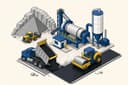 AsphaltHot paving mix from 71 plants next to the quarries: $1,294.4M of sales in 2025 on 13.4 million tons. Tons keep slipping while the price per ton rises, and it is the earning half of Vulcan's two mixing businesses.
Hot paving mix from 71 plants next to the quarries: $1,294.4M of sales in 2025 on 13.4 million tons. Tons keep slipping while the price per ton rises, and it is the earning half of Vulcan's two mixing businesses.
In plain English
The black top layer of a road is mostly stone. Vulcan's plants heat its own crushed rock and stir in the sticky tar left at the bottom of an oil refinery, then send it out hot — the crew has to spread it before it cools, which is why the plants sit near both the quarry and the job.
State road agencies and their paving contractors buy it by the ton, and Vulcan's crews also lay some of it. So the stone earns twice: once going into the mixer, once inside the finished pavement. Management expects about 85% of this year's roughly $290 million of mixing cash profit to come from asphalt rather than concrete.
Competes with Asphalt (CRH Americas Materials) · Asphalt and paving services (Martin Marietta)
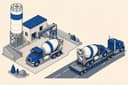 Ready-Mixed ConcreteWet concrete delivered from 76 plants: $846.6M of sales in 2025 but only $35.9M of profit. Vulcan is shrinking it on purpose — after the California sale closed in June 2026 the line runs nearer 9% of revenue.
Wet concrete delivered from 76 plants: $846.6M of sales in 2025 but only $35.9M of profit. Vulcan is shrinking it on purpose — after the California sale closed in June 2026 the line runs nearer 9% of revenue.
In plain English
Concrete is rock, sand, cement powder and water, mixed wet and driven to a site in one of those trucks with the slowly turning drum. The clock starts when the water goes in, so a plant can only serve what is about half an hour away.
It is a thin living. Vulcan has to buy the cement — the one ingredient it does not make — from someone else, and every rival inside that half hour sells the same grey slurry. So it sold the California plants to CalPortland, owned by Taiheiyo Cement, for about $712 million in June 2026 and kept the quarries that had been feeding them. The logic: keep the rock, sell the mixer.
Competes with Ready-mixed concrete (CalPortland) · Ready mixed concrete (Martin Marietta)
Named in filings, launches and programs
- Wake Stone CorporationBrandA Carolinas family quarry business bought at the end of 2024 — pure crushed stone, no mixing plants attached.
- Brannan Sand & GravelProduct lineA rail-connected quarry at Lamar, Colorado plus a Dallas–Fort Worth yard, bought the same day the California concrete plants were sold.
- Superior Ready MixBrandBought in late 2024 for its Southern California footprint; the mixing plants went in June 2026 and the quarries stayed.
- Brooksville calcium operationProduct lineA leased Florida quarry whose stone becomes an animal-feed supplement; counted inside the rock business since early 2024.
- Railroad ballastProduct lineCoarse graded stone sold for the beds that hold heavy rail track in place.
- Recycled materialsProduct lineOld concrete and asphalt broken down and sold again as fill and base stone.
- Clean construction debris disposalServiceContractors pay to drop clean fill at Vulcan sites — a small earner from space a quarry already has.
- Asphalt paving servicesServiceCrews that lay the mix as well as sell it, counted inside the asphalt business.
- Liquid asphalt storage terminalsEcosystemTanks holding the tar that binds paving mix, including a Southern California facility — a hedge on the ingredient Vulcan must buy.
- Legacy U.S. Concrete plants, Virginia / D.C.Product lineThe ready-mix footprint kept after the pruning — a couple of plants around Virginia and Washington, D.C.
Wake Stone CorporationBrand
A Carolinas family quarry business bought at the end of 2024 — pure crushed stone, no mixing plants attached.
Brannan Sand & GravelProduct line
A rail-connected quarry at Lamar, Colorado plus a Dallas–Fort Worth yard, bought the same day the California concrete plants were sold.
Superior Ready MixBrand
Bought in late 2024 for its Southern California footprint; the mixing plants went in June 2026 and the quarries stayed.
Brooksville calcium operationProduct line
A leased Florida quarry whose stone becomes an animal-feed supplement; counted inside the rock business since early 2024.
Railroad ballastProduct line
Coarse graded stone sold for the beds that hold heavy rail track in place.
Recycled materialsProduct line
Old concrete and asphalt broken down and sold again as fill and base stone.
Clean construction debris disposalService
Contractors pay to drop clean fill at Vulcan sites — a small earner from space a quarry already has.
Asphalt paving servicesService
Crews that lay the mix as well as sell it, counted inside the asphalt business.
Liquid asphalt storage terminalsEcosystem
Tanks holding the tar that binds paving mix, including a Southern California facility — a hedge on the ingredient Vulcan must buy.
Legacy U.S. Concrete plants, Virginia / D.C.Product line
The ready-mix footprint kept after the pruning — a couple of plants around Virginia and Washington, D.C.